building a second home in Thailand
A second home in Thailand where the owner's name is not on that house's household registration is taxed from the first baht of assessed value, starting at 0.02% and rising with value. Financing normally caps at 80-90% LTV, but a temporary rule allows up to 100% for homes under 10 million baht from the second contract onward, now extended to contracts signed by June 2027.
- A second home owes land and building tax from the first baht, without the 50 million baht exemption a primary residence gets.
- The 2026 tax rate is tiered, starting at 0.02% and climbing as assessed value rises.
- Second-home loans are normally capped at 80-90% LTV, with a temporary rule allowing up to 100%.
- Building on land takes approximately 6 months to up to 1 year depending on the number of storeys.
Building a Second Home in Thailand: Ready-Made or Built on Land
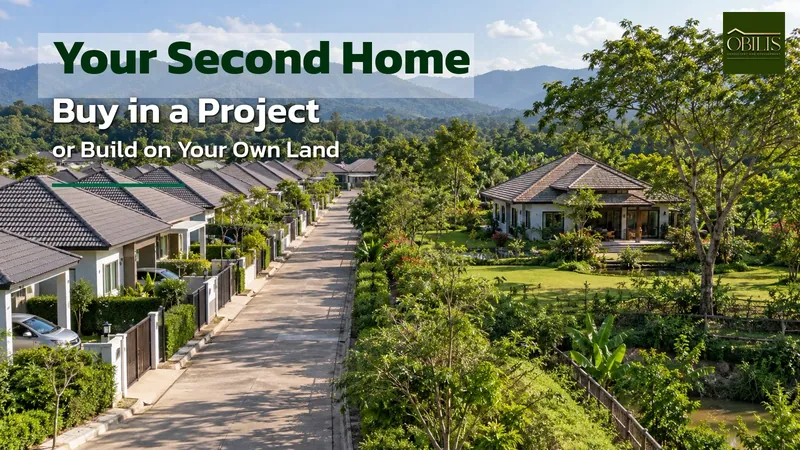
People working in Bangkok who want a second home in Thailand usually weigh two paths. The first is buying a finished house inside a gated project. The second is buying raw land, or using land the family already owns, and building from scratch. Both paths can lead to Khao Yai or Korat, but the conditions along the way are very different.
Buying into a project means buying a layout someone else already designed. The floor plan is fixed and rarely changes. Some projects around Pak Chong sell move-in-ready houses that can transfer within a few months, which suits someone who wants a second home quickly and does not want to manage a construction process.
Building on land, whether it is land the family already holds or land bought for this purpose, gives more freedom to lay out rooms around how the family actually spends its weekends. It simply takes longer, and the owner has to make more decisions from the start, from choosing the site to choosing the house design.
Khao Yai or Korat: Choosing the Right Location for How You Will Use It
Khao Yai and Pak Chong suit people who want a weekend retreat close to attractions and restaurants. Land here costs more than in other zones, and the plots with the best views often sit far from the main road, so access and slope need careful checking before deciding.
Korat city suits people who see the second home as a long-term asset, perhaps as a future retirement house. Travel is easier, and it sits closer to major hospitals and the airport. Land prices here are still more affordable than in Khao Yai.
If the family already owns land around Korat or Roi Et, building on that existing plot is usually better value than buying into a new project, since there is no second land purchase. It is worth noting here that foreigners generally cannot personally own land in Thailand, so a foreign buyer weighing land versus a project house needs to plan land ownership structure carefully before committing to either path.
Land and Building Tax on a Second Home
A second home, where the owner’s name is not listed on that house’s household registration, does not qualify for the first 50 million baht tax exemption that applies to a primary residence. It is taxed from the first baht of the assessed value under Thailand’s land and building tax, whether that house was bought from a project or built from scratch.
The tax rate in effect for 2026 is tiered. It starts at 0.02% of assessed value for the first 50 million baht, then rises to 0.03% for the next band, and climbs further to 0.05% and 0.10% as the assessed value rises again.
This tax should be counted as part of the annual holding cost, not just the one-time purchase price at transfer. Both a project house and a self-built house count equally as a second home for tax purposes, as long as the owner’s household registration is still listed in Bangkok.
Financing a Second Home: LTV Rules to Know Before Planning
For a loan on a second residential property, or a property bought for investment, the Bank of Thailand normally caps LTV (loan-to-value, the share of the property’s value a bank will lend) at 80-90% of the property’s value. That means the borrower must cover 10-20% of the price as a down payment.
The Bank of Thailand’s temporary relaxation allows loans of up to 100% of the collateral value from the second contract onward for homes under 10 million baht, and it has been extended to cover contracts signed from 1 July 2026 to 30 June 2027. Banks still assess the borrower’s income and repayment history as usual.
Anyone planning to buy a second home within this window should raise this condition with the bank early, since it changes the size of the down payment needed. Someone building on land instead usually takes a construction loan, which the bank assesses against the house design and the completed work at each stage.
Timeline and Risk Along the Way if You Build
Buying a move-in-ready house in a project carries almost no timeline risk, since the buyer sees the finished house before transfer. But a fixed floor plan may not match how the family actually spends its weekends there, such as a balcony too small for the outdoor breakfasts the family had imagined.
Building on land takes longer. A single-storey house typically takes approximately 6 months or less, while a typical two-storey house takes approximately up to 1 year. These figures are industry averages, not official government figures, and a given site can take longer depending on ground conditions.
During construction, the owner has to decide on design and materials at several points. Anyone still based mainly in Bangkok should ask the builder from the outset how progress will be communicated, so misunderstandings do not surface once the work is already well underway.
Deciding From a Distance: Managing a Second Home With Confidence
People still based in Bangkok routinely make second-home decisions over video calls. They view the actual land through footage the team records, review the house design through a 3D model, and only travel down for the moments that need it, such as signing the contract or inspecting the finished structure.
Choosing a project house makes remote oversight simpler, since the project’s management company (juristic person) handles common areas. Choosing to build means looking for a builder that works to a clear system, with defined inspection stages, so the owner can see real progress even without being on site every day.
OBILIS regularly works this way with owners building second homes around Khao Yai and Korat. Whichever path is chosen, buying into a project or building from scratch, the same discipline applies: count both the tax and the ongoing upkeep as part of the cost before deciding, not just the price on the day of purchase.
If you want a rough figure for the house you have in mind, try the budget planner first, or contact us for advice based on your actual plan and land.
Frequently Asked Questions
Which takes less time: buying a second home in a Khao Yai project, or building on land in Korat?
Buying a move-in-ready house in a project takes less time, since it can transfer as soon as the sale is agreed. Building on land instead takes approximately 6 months to up to 1 year, depending on whether it is a single-storey or two-storey house.
How much land and building tax does a second home owe?
A second home where the owner’s name is not on that house’s household registration is taxed from the first baht of assessed value, at a tiered rate starting at 0.02% and rising as the value increases, at the rates in use for 2026.
What percentage of a second home’s value can be financed?
Normally up to 80-90% of the property’s value can be financed, but the Bank of Thailand’s temporary relaxation allows up to 100% for homes under 10 million baht from the second contract onward, extended to contracts signed by 30 June 2027.
Key facts at a glance
| Land and building tax, first tier | 0.02% of assessed value, from the first baht |
|---|---|
| Higher tax tiers | 0.03%, 0.05%, 0.10% as value rises |
| Normal LTV for a second home | Up to 80-90% of property value |
| Temporary LTV relaxation | Up to 100%, contracts signed by June 2027 (extended) |
| Condition for the relaxation | Homes under 10M baht from the 2nd contract; 10M baht and up from the 1st |
| Approximate construction time | Single-storey ~6 months or less; two-storey ~up to 1 year |
Frequently asked questions
Which is faster: buying a second home in a Khao Yai project, or building on land in Korat?
Buying a move-in-ready project house is faster, since it can transfer as soon as the sale is agreed, while building takes approximately 6 months to 1 year.
How much land and building tax does a second home owe?
It is taxed from the first baht of assessed value at a tiered rate starting at 0.02%, rising as the value increases, at the 2026 rates.
What percentage of a second home's value can be financed?
Normally up to 80-90%, but a temporary relaxation allows up to 100% for contracts signed by June 2027.
Is building on family-owned land near Korat or Roi Et better than buying a new project?
It is usually better value, since there is no second land purchase and the layout can better fit the existing plot.