Mountain-View Land Near Khao Yai: What to Prepare Before Building a House
Buying mountain-view land near Khao Yai requires verifying boundaries with the land office and national parks authority first, since real cases of overlap with forest reserve land exist and encroachment penalties are severe. Buyers also need to budget for grading and retaining-wall costs driven by slope, confirm electricity and water availability, and check that the access road can genuinely handle construction vehicles before putting down a deposit.
- Verify land boundaries with the land office and national parks authority first.
- Budget separately for grading and retaining-wall costs driven by slope.
- Confirm PEA electricity access and a real water source before buying.
- Check that the access road is public and can handle construction vehicles.
Mountain-View Land for a House: How It Differs From Ordinary Land
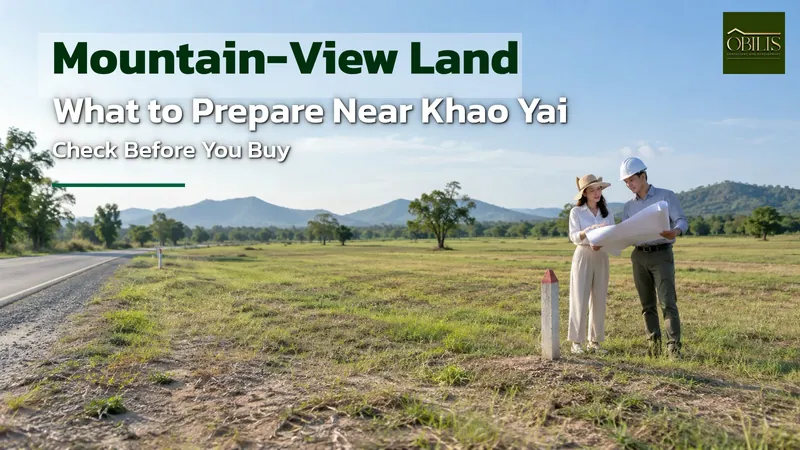
Mountain-view land for a house near Khao Yai and Pak Chong usually costs noticeably more than flat land nearby, because buyers pay a premium for the view. What hides behind a beautiful view, though, is a set of constraints around slope, utilities, and access that buyers of ordinary in-town land rarely run into.
Buying this kind of plot means checking far more carefully than flat land on several fronts — from the title deed, to boundaries that might overlap forest reserve or national park land, to the real slope of the site, which aerial photos often make look flatter than it actually is.
Walking the land yourself on a rainy day, or right after rain, reveals problems a sunny-day visit never shows — where water actually flows, how well the soil holds water, and whether any spot stays waterlogged for an unusually long time.
Check the Boundary Before Buying — Don’t Just Trust the Markers You See
The area around Khao Yai and Pak Chong has real, documented cases of land overlapping forest reserve or national park boundaries. Verifying the boundary with the land office and the national parks authority before paying matters far more than trusting whatever marker the seller or agent happens to point at.
Thailand’s National Parks Act B.E. 2562 (2019) sets severe penalties for encroaching on or occupying national park land — imprisonment of 4 to 20 years, or a fine of 400,000 to 2,000,000 baht (according to news reports citing the National Parks Act B.E. 2562) — which is exactly why the boundary must be confirmed before a single pile goes into the ground.
The safest route is to have the land office re-survey the boundary before transfer, and to check directly with the regional protected area office that the plot in question sits outside the park boundary — not to take the seller’s word for it alone.
How Much Does Sloped Land Add to a Construction Budget
Mountain-view land typically has enough slope that the site needs grading before the foundation goes in — whether that means cutting away soil in some spots or filling in lower ones — and that’s a cost most standard house-construction quotes don’t include.
Steeply sloped land can also require special foundation work, such as longer piles where the soil runs deep, or a reinforced retaining wall to stabilize the house pad — costs that should be estimated while still looking at the land, not discovered only once the house plan comes back.
This part of the budget varies enormously from plot to plot, depending on the real slope, how far soil has to be hauled, and the soil type — so it’s worth having a designer or engineer visit the site before committing to buy, rather than guessing based on what another plot cost.
How Complete Are the Utilities on Mountain-View Land, Before You Decide
Many plots of mountain-view land sit far from existing electricity and water infrastructure. Extending a Provincial Electricity Authority (PEA) line to land with no power pole nearby involves a process and cost that should be checked directly with the local PEA office before buying, since some plots may need the line extended quite a distance.
Land with no mains water connection usually relies on a groundwater well or rainwater storage as its main water source — both work fine with the right system in place, but it’s an added cost that land inside a town simply doesn’t carry.
Before buying mountain-view land, walk the area and ask neighboring landowners where they actually get their water and power, since what people living there tell you is usually far more accurate than a sales listing’s claim that electricity and water are “ready.”
Access Roads: The Detail Buyers Overlook Most Often
Many beautiful plots of mountain-view land have access that’s a dirt track or a narrow lane that a concrete truck or materials delivery truck simply can’t reach — which directly affects both construction logistics and everyday convenience once you’ve moved in.
Check whether the access road is a registered public road, or a path across someone else’s land that could be blocked off in the future, because a beautiful title deed with no legally secure access can make building far harder than expected.
If the access road needs upgrading — widening the surface, or pouring a concrete driveway strong enough for vehicle loads — factor that cost into the buying decision up front, since it’s a budget line that often gets overlooked until it turns into a mid-project surprise.
Have a Designer Assess Mountain-View Land Before You Commit to Buying
Deciding to buy mountain-view land near Khao Yai is far safer with a designer or engineer walking the site before you sign the sale agreement, because someone with hands-on experience spots problems that a photo set, or a single walk-through, never reveals.
OBILIS has walked mountain-view sites for several homeowners around Khao Yai and Pak Chong before they committed to buying, assessing slope, boundary, and utility readiness together in one visit.
To get a rough idea of your budget, try the house budget planner, or contact the team to discuss the details.
If you’re considering mountain-view land, get an experienced opinion before putting down a deposit — the cost of assessing land before buying is far smaller than the cost of fixing hidden constraints after you already own it.
Frequently Asked Questions
How much more does mountain-view land near Khao Yai cost per rai than flat land?
It varies hugely from plot to plot depending on the view angle and distance to the main road, so there’s no fixed figure that applies everywhere. Compare several mountain-view plots in the same area before deciding, rather than trusting a single agent’s asking price.
How do I know if land overlaps a forest reserve?
You need the local land office to verify the boundary together with data from the Department of National Parks, Wildlife and Plant Conservation — markers placed by the previous owner alone aren’t reliable, since un-resurveyed markers can drift from the true boundary.
Can I still build on very steeply sloped land?
Yes, but budget for site grading, special foundations, and a retaining wall that may be needed. Slope isn’t a reason you can’t build — it’s a factor that has to be budgeted honestly against the real condition of that specific plot.
Key facts at a glance
| Penalty for national park encroachment | 4-20 years imprisonment or a 400,000-2,000,000 baht fine (National Parks Act B.E. 2562) |
|---|---|
| Required pre-purchase check | Boundary verification with the land office and national parks authority |
| Cost often missing from standard quotes | Grading and special foundation work for sloped sites |
| Backup water source where there's no mains supply | A groundwater well or rainwater storage |
| Electricity item to confirm | PEA line extension distance to the plot |
| Commonly overlooked item | Whether the access road is genuinely a public road |
Frequently asked questions
How much more does mountain-view land near Khao Yai cost per rai?
It varies hugely by view angle and distance to the main road, so compare several plots rather than trusting one listing price.
How do I know if land overlaps a forest reserve?
The land office must verify the boundary together with the national parks department; a previous owner's markers alone aren't reliable.
Can I still build on very steeply sloped land?
Yes, but budget honestly for grading, special foundations, and a possible retaining wall.
What's the penalty for encroaching on national park land?
Under the National Parks Act B.E. 2562, penalties run from 4 to 20 years imprisonment or a fine of 400,000 to 2,000,000 baht.