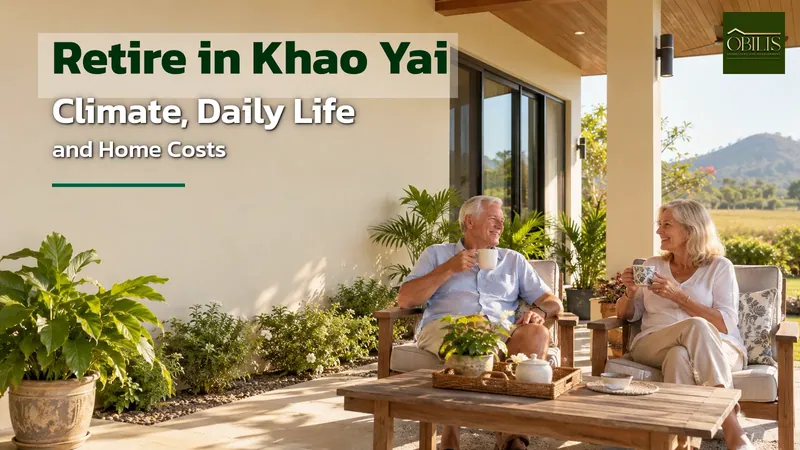
Retire in Khao Yai and what it really costs and feels like day to day
Retiring in Khao Yai means cooler mornings, a rural pace built around Pak Chong and Korat, and healthcare that requires driving rather than walking. The rainy season runs approximately mid-May to mid-October, and a nature home's cost depends mainly on the land itself rather than any fixed price per square metre. The Non-Immigrant O-A retirement visa, for applicants aged 50 and over, generally needs a Thai bank deposit of approximately 800,000 baht or monthly income of approximately 65,000 baht.
- Khao Yai is cooler than Bangkok for most of the year, with a rainy season running approximately mid-May to mid-October.
- Pak Chong covers daily needs, while Korat offers bigger hospitals and shopping about an hour away.
- There is no fixed standard price for a nature home; sloped land generally costs more to build on than flat land.
- The Non-Immigrant O-A retirement visa generally requires a Thai bank deposit of approximately 800,000 baht or monthly income of approximately 65,000 baht.
What it is really like to retire in Khao Yai
To retire in Khao Yai means trading a city routine for mornings that start cool and quiet, with hills and forest close enough to see from your garden. The area sits around Khao Yai National Park and the town of Pak Chong, within reach of Korat for bigger shopping and hospitals. Retirees who move here are usually looking for lower noise, cleaner air and a slower pace, not a resort lifestyle.
The decision to retire in Khao Yai usually comes after a visit, not before one. Many retirees rent for six months to a year first, to see how the rainy season feels and how far they are willing to drive for groceries, before committing to buy land or build. That trial period also gives time to meet local builders and compare how different areas handle slopes, flooding and road access.
This guide looks at the climate, the daily rhythm, healthcare access and the rough cost of building a home, so the picture is realistic rather than a holiday brochure version of the area.
The climate you retire into in Khao Yai
Khao Yai sits higher and closer to forest cover than most of the Isaan plain, so mornings and evenings are noticeably cooler than Bangkok for most of the year. Afternoons still get warm, especially from March to May, but the heat rarely feels as heavy as it does in the capital.
The rainy season runs approximately from mid-May to mid-October, with the heaviest and most frequent rain in the middle of that window. Roads in low-lying spots can flood briefly after a hard downpour, and a house built on a slope needs good drainage to cope with run-off rather than just rain falling straight down.
Outside the rainy season, the cooler months from around November to February are what draw many retirees to the area in the first place. A house designed with cross-ventilation and deep roof overhangs stays comfortable through most of the year without leaning on air conditioning constantly.
Daily life for retirees near Khao Yai and Pak Chong
Daily life near Khao Yai revolves around Pak Chong town for everyday shopping, fresh markets and basic services, with Korat city about an hour or so away by car for larger malls, specialist shops and bigger hospitals. A car is close to essential here, unlike a condo life in central Bangkok.
Retirees who settle well tend to build a routine around the cooler morning hours: walking, gardening or visiting a local market before the afternoon heat sets in. Internet and mobile coverage around Pak Chong is generally reliable enough for video calls home, though it is worth checking the specific plot before committing, since coverage can vary on more remote hillside land.
Social life is quieter than in a beach town or a big expat hub. Some retirees join the small foreign community around Khao Yai through wineries, golf clubs or cafes, while others prefer the privacy of a rural plot with occasional trips into town. Either way, it helps to decide this before choosing how close to town to build.
Healthcare and getting around once you retire in Khao Yai
Healthcare is one of the first things to plan around when you retire in Khao Yai, because the area itself is rural. Pak Chong has local hospitals for everyday needs, and larger private and public hospitals are available in Korat city for more serious or specialist care.
For retirees with ongoing health conditions, it is worth visiting the hospitals in person before committing to a plot of land, rather than assuming distance alone tells the full story. Travel time can matter more than the straight-line distance, especially during heavy rain or on hillside roads.
Health insurance also matters here for practical reasons, not only visa rules. A policy that covers treatment at hospitals in Korat, and evacuation to Bangkok if needed, gives more peace of mind than relying on a nearby clinic alone.
What a nature home near Khao Yai costs to build
There is no fixed standard price for a retirement home near Khao Yai, because the cost depends heavily on the land itself, how far it is from the main road, and whether the plot is flat or sloped. A single-storey home built for ease of movement later in life typically costs more per square metre than a two-storey house of the same floor area, because the roof and foundation cover more ground.
Sloped or hillside plots usually add to the foundation cost, since they often need engineered footings rather than a simple flat slab. Flat land close to an existing road, with electricity and water connections nearby, keeps costs more predictable.
Because there is no official benchmark price for a retirement home specifically, it is worth asking any builder for a detailed, itemised quote rather than a single lump sum, so it is clear what is included and what might be added later, such as a water storage tank or solar backup for the rainy season.
Visa and legal basics before you retire in Khao Yai
Before you retire in Khao Yai and start building, it helps to separate the visa question from the building question, since they run on different timelines. The Non-Immigrant O-A retirement visa, for applicants aged 50 and above, generally requires a Thai bank deposit of approximately 800,000 baht, or a monthly income of approximately 65,000 baht, along with health insurance cover, with permission to stay extended one year at a time and no permission to work.
Foreigners generally cannot own land in Thailand outright under the Land Code, so a retirement home is usually built on leased land, on land held by a Thai spouse, or through another arrangement that a Thai lawyer should review before you sign anything. OBILIS can build on leased land or on land owned by a Thai spouse, with the correct paperwork in place, and designs and builds as one team working around Khao Yai and Korat.
To see a first budget range for the home you have in mind, try the budget planner, or contact us with the area you are considering and how you plan to hold the land.
This is general information, not legal advice. Confirm the current visa requirements with the Thai embassy or consulate handling your application, and confirm land and lease arrangements with a Thai lawyer and the Land Office before signing anything.
If you are planning to build a house in Thailand as a foreigner for retirement near Khao Yai, settle the land arrangement first and visit the plot in both the rainy and the cool season before fixing the design.
Frequently asked questions
Is Khao Yai too remote for a comfortable retirement?
It depends on what comfortable means to you. Pak Chong covers daily needs, and Korat is close enough for bigger shopping and hospitals. It suits retirees who prefer quiet and nature over having everything within walking distance.
What visa lets a foreigner retire in Khao Yai long-term?
Many retirees use the Non-Immigrant O-A retirement visa, available from age 50, with a Thai bank deposit of approximately 800,000 baht or monthly income of approximately 65,000 baht plus health insurance, extended one year at a time. This is general information, not legal advice, so confirm current rules with the Thai embassy before applying.
How much should a retiree budget to build a home near Khao Yai?
There is no fixed standard price, since land type and distance from the road affect cost the most. Flat land near existing utilities keeps the build more predictable, while sloped land usually adds to the foundation cost. Ask any builder for an itemised quote rather than a single total.
Key facts at a glance
| Rainy season | approximately mid-May to mid-October |
|---|---|
| Retirement visa minimum age | 50 |
| O-A financial requirement | approximately 800,000 baht bank deposit or 65,000 baht monthly income |
| Nearest bigger hospitals | Korat city, about an hour's drive from Pak Chong |
| Land ownership | Foreigners generally cannot own land outright under the Land Code |
| Home building cost | No fixed standard price; depends on land type and distance from utilities |
Frequently asked questions
Is Khao Yai too remote for a comfortable retirement?
It depends on what comfortable means to you. Pak Chong covers daily needs and Korat is close enough for bigger shopping and hospitals.
What visa lets a foreigner retire in Khao Yai long-term?
Many retirees use the Non-Immigrant O-A retirement visa, available from age 50, with a Thai bank deposit of approximately 800,000 baht or monthly income of approximately 65,000 baht plus health insurance, extended one year at a time.
How much should a retiree budget to build a home near Khao Yai?
There is no fixed standard price, since land type and distance from the road affect cost the most.
Can a foreigner own the land for a retirement home near Khao Yai?
Generally not outright under the Land Code; most retirees build on leased land or land held by a Thai spouse, confirmed with a Thai lawyer first.