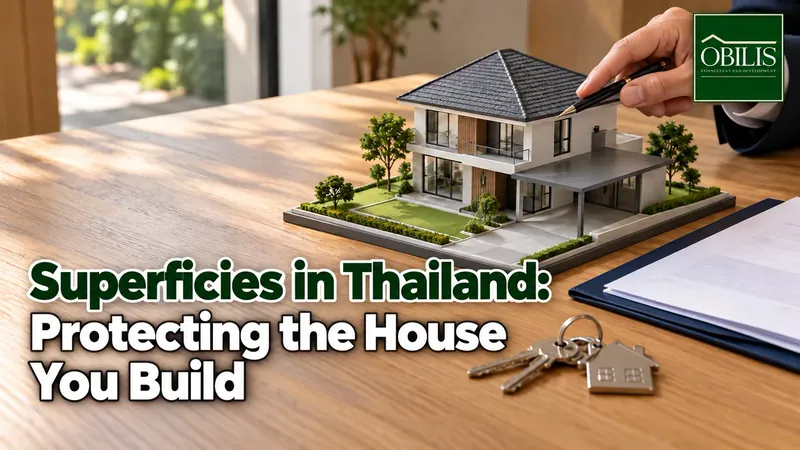
Superficies in Thailand: what is it and how does it work?
Superficies in Thailand is a registered right that lets someone own a building on land owned by another person, separate from ownership of the land itself. It is often used by foreigners who build a house on land held by a Thai spouse or landowner. The right generally lasts up to approximately 30 years, or for the holder's lifetime, once registered at the Land Office. This is general information, not legal advice.
- Superficies gives ownership of a building separately from ownership of the land beneath it.
- It must be registered at the Land Office to count as a real right against future owners.
- The term is generally up to approximately 30 years, or for the holder's lifetime if registered by an individual.
- It is one of three options foreigners compare alongside usufruct and a registered lease.
What superficies in Thailand actually means for your house
Superficies in Thailand is a registered right that lets someone own a building standing on land owned by someone else. For a foreigner who cannot own the land under a house, this is one of the legal tools that keeps the house itself under their own name, separate from who owns the plot beneath it.
The right comes from the Civil and Commercial Code, in the sections dealing with superficies, generally cited as sections around 1410 to 1416. Once registered at the Land Office, it is treated as a real right, not just a private promise between the landowner and the person who built the house.
Several English-language legal guides, including notes from the Luther law firm and the Terms.law property series, describe the maximum term as approximately 30 years, or for the life of the landowner or the person holding the right, when that person is an individual. This is general information, not legal advice; confirm the current term and section numbers with a Thai lawyer and the Land Office before you sign anything.
Why foreigners building near Khao Yai or Korat look at superficies
Most foreigners who want to build a house in Thailand cannot own the land it stands on. Superficies in Thailand gives a practical way to separate the two: a Thai landowner, often a spouse or a long-term lease counterpart, keeps the land, while the person who paid for and built the house holds a registered right to the structure itself.
This matters in areas like Khao Yai and Korat, where many foreign buyers build a retirement or holiday home on land held by a Thai spouse or on leased land. Without a registered right of some kind, the house legally belongs to whoever owns the land underneath it.
Superficies is one of three tools commonly discussed for this situation, alongside usufruct and a registered lease. Each works differently, and the right choice depends on who owns the land, the relationship between the parties, and how long the arrangement needs to last.
Superficies compared with usufruct and a registered lease
A usufruct gives a person the right to use and enjoy someone else’s land, generally for up to approximately 30 years, or for the holder’s lifetime if that person is an individual. Unlike superficies, which can generally be transferred and inherited, a usufruct is tied to using the land itself and ends when the holder dies, so it cannot be passed on to heirs.
A registered lease of land can run for up to approximately 30 years under the Civil and Commercial Code, and any lease longer than three years must be in writing and registered at the Land Office, or it is only enforceable for three years. A lease does not give ownership of the building; it gives the right to occupy and use the land for the agreed term.
Superficies is different from both because it gives ownership of the building itself as a separate real right from the land. For a self-built house, this is often the closest a foreigner can get to something that feels like owning the home, even though the land underneath remains someone else’s property.
Registering superficies at the Land Office
None of these rights offer real protection until they are registered at the Land Office. An unregistered agreement, however detailed, is treated as a private arrangement between the parties and does not bind a new owner if the land is sold.
Registration involves both the landowner and the person receiving the right attending the Land Office together, with the correct supporting documents for the land title and the identities of both parties. The exact paperwork can vary between offices, so confirming the current requirements locally before the appointment saves a wasted trip.
Fees apply at registration and differ by right and by the value involved, so no figure is given here. This is general information, not legal advice; confirm the current fees and documents with a Thai lawyer and the Land Office before you sign anything.
What this means for the build itself, not just the paperwork
Getting the legal right sorted out before construction starts matters because the building permit is usually applied for in the name of whoever will hold rights to the structure, with the landowner’s written consent attached. Sorting out superficies, usufruct, or a lease after the house is already built creates extra paperwork and extra risk.
It also affects what happens if the relationship between the parties changes, for example if a Thai spouse and foreign partner separate, or if a landowner wants to sell. A registered right survives a change of landowner in a way that an informal family agreement does not.
For a couple building together, deciding early who will hold which right, and registering it before or very soon after the land is ready, avoids a situation where the house is finished but its legal status is still unclear.
Getting the legal and construction sides working together
Superficies, usufruct, and lease registration are legal steps handled by a lawyer and the Land Office, separate from the construction contract and the building permit. Keeping the two processes lined up, so the registered right is in place before or alongside the permit application, avoids delays once the design is ready.
OBILIS designs and builds houses around Khao Yai, Korat, and Roi Et, and can provide construction contracts and a BOQ in English so a foreign owner or their lawyer can review exactly what is being built, even while the land-rights paperwork is being finalised separately.
To see a first budget range for your plot, try the budget planner, or contact us with your land documents and a rough brief.
This is general information, not legal advice. Confirm the current rules for superficies, usufruct, and lease registration with a Thai lawyer and the Land Office before you sign anything or start construction.
If you are looking for a custom home builder near Khao Yai and Korat, sort out who will hold the land right first, then bring those documents to the first design meeting.
Frequently asked questions
Is superficies in Thailand the same as owning the land?
No. Superficies in Thailand only gives a registered right to own the building standing on the land; the land itself still belongs to whoever held it before the right was created, and that does not change just because a house is built on it.
Can a foreigner register superficies without a Thai spouse?
Superficies can be registered between a foreigner and any Thai landowner, not only a spouse, as long as the landowner agrees and both parties complete registration at the Land Office. This is general information, not legal advice; confirm your specific situation with a Thai lawyer.
What happens to superficies if the land is sold?
Once registered, superficies is treated as a real right tied to the land, so it generally continues even if the land changes owners. Confirm this with the Land Office and a Thai lawyer before relying on it for your own situation.
Key facts at a glance
| Superficies term | Approximately 30 years, or for the holder's lifetime if an individual (per secondary legal sources) |
|---|---|
| Usufruct term | Approximately 30 years, or for the holder's lifetime if an individual |
| Lease term | Up to approximately 30 years under the Civil and Commercial Code |
| Lease writing requirement | A lease longer than 3 years must be written and registered, or it is enforceable for only 3 years |
| Registration authority | The Land Office (Thailand) |
| Legal basis | Thai Civil and Commercial Code, superficies sections (around 1410-1416) |
Frequently asked questions
Is superficies in Thailand the same as owning the land?
No, it only covers ownership of the building; the land itself still belongs to the original landowner.
Can a foreigner register superficies without a Thai spouse?
Yes, as long as the landowner agrees and both parties register the right together at the Land Office.
What happens to superficies if the land is sold?
It generally continues as a registered right tied to the land, but this should be confirmed with the Land Office and a Thai lawyer.
How is superficies different from a registered lease?
A lease gives the right to use land for a fixed term, while superficies gives ownership of the building itself as a separate right from the land.