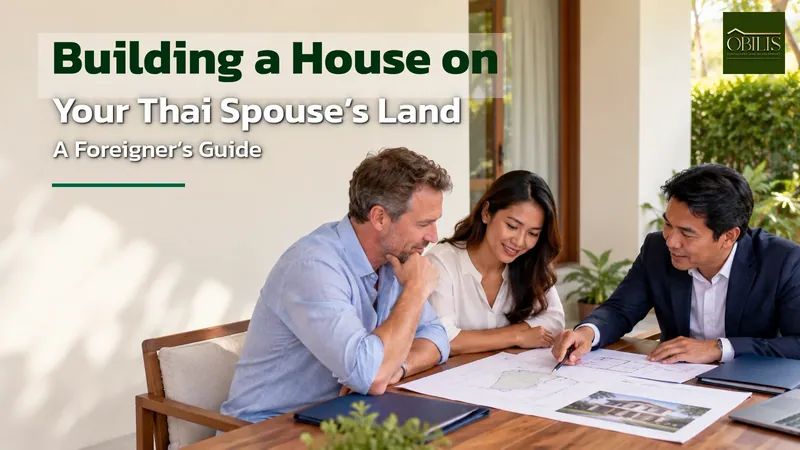
Building a house on your Thai spouse's land: what should you check first?
Building a house on your Thai spouse's land does not give the foreign spouse any automatic ownership, because foreigners generally cannot own land in Thailand and the building usually follows the land unless a separate right is registered. Registering a superficies right, a usufruct, or a long-term lease, often together, lets the foreign spouse hold a real, recognised interest in the house itself. This should always be arranged with a Thai lawyer and the Land Office before construction begins.
- Foreigners generally cannot own land in Thailand, even when married to a Thai national.
- Without a registered right, a house built on the land usually belongs to the landowner.
- Superficies and usufruct rights can give a foreign spouse a real interest in the house.
- A registered 30-year lease is another common route, often combined with superficies.
Building a house on your Thai spouse’s land: the legal starting point
Building a house on your Thai spouse’s land is common around Khao Yai and Korat, where many foreign husbands and wives settle for retirement or a quieter life. The starting point is simple: foreigners generally cannot own land in Thailand under the Land Code, so if the land is registered in your Thai spouse’s name, you have no automatic ownership of it, no matter who pays for the house built on top of it.
This surprises people who assume that marriage changes the rule. It does not. At the Land Office, both spouses typically have to confirm in writing that the money used to buy the land is the Thai spouse’s own separate property, so the foreign spouse does not gain any land rights through the purchase.
None of this means a foreign spouse cannot build and keep a real interest in the house. It means the protection has to be set up deliberately, in writing, and registered, rather than assumed from the marriage itself.
Why the house can become part of the land if nothing is registered
Under Thai civil law principles, a building generally becomes part of the land it stands on, unless a separate right has been registered. That matters a great deal if you build a house with your own money on land that is only in your Thai spouse’s name.
Without any registered protection, the house you paid for can end up belonging to the landowner, your spouse, in the same way any other structure on their land would. This is not usually a problem while the marriage is stable, but it becomes one if the relationship changes or if there is a dispute later.
The fix is not complicated in principle: register a right over the land, in the foreign spouse’s name, before or alongside building the house, so the law recognises a separate interest in the structure rather than treating it as simply part of the land.
Superficies and usufruct: giving the foreign spouse real rights
Two registered rights come up most often for this situation: superficies and usufruct. A superficies right generally lets the foreign spouse own the building constructed on the land, separately from ownership of the land itself, which stays with the Thai spouse.
A usufruct is different: it generally gives the holder the right to use and enjoy the land, which can support living in a house built there, but it typically ends on the holder’s death and cannot be passed on. Many foreign spouses register both together, so one covers the structure and the other covers the right to use the land during their lifetime.
Durations and renewal terms for these rights are described differently across the sources we checked, so always have a Thai lawyer confirm the exact terms, and whether both rights suit your situation, before you register anything.
A registered lease as the other common route
A registered lease of the land is the other route many couples use instead of, or alongside, superficies and usufruct. Thai law generally allows a lease of land for up to 30 years, and a lease longer than three years must be in writing and registered at the Land Office to be enforceable for the full term.
A lease on its own only gives the right to use the land for that period; it does not by itself give the foreign spouse ownership of the house built on it. That is why many people combine a registered lease with a superficies right, so the structure is clearly owned separately from the land.
Be careful with promises of automatic renewal, sometimes described as a “30+30+30” arrangement. Thai courts have ruled that this kind of pre-agreed automatic renewal is not enforceable in the way sellers sometimes describe it, so never treat a renewal promise as guaranteed.
Building a house on your Thai spouse’s land: what to put in writing before you build
Building a house on your Thai spouse’s land works best when the paperwork is sorted before the first delivery of cement arrives, not after the house is finished. Decide together which right, or combination of rights, you will register, and do it at the Land Office alongside, or before, construction starts.
It is also worth asking what happens to the house if the marriage ends, or if your spouse passes away first. A separate written agreement between spouses, on top of the registered rights, can set out what each person intends, even though it cannot override the land ownership rules themselves.
This is general information, not legal advice — confirm the details of your situation with a Thai lawyer and the Land Office before you sign anything or start building.
Working with a builder who understands this situation
A builder who has worked through this situation before can also make the practical side easier. OBILIS can build on leased land or on land owned by a Thai spouse, provided the correct legal paperwork is in place first, and keeps construction contracts and the BOQ available in English so both spouses can follow exactly what is being built and billed.
To see a first budget range for the house you have in mind, try the budget planner, or contact us with your land documents and the rights you plan to register.
Ask any builder to confirm in writing that they have checked which registered right is in place before they start, since the permit application itself is usually made in the name of whoever holds the right to the land or the building.
Keeping the legal step and the building step aligned, rather than rushing to start construction before the paperwork is registered, is the single most useful thing a foreign spouse can do to protect the house once it is built.
If you are thinking about building a home in Thailand on your spouse’s land, settle which right will be registered first, then bring those documents to the first design meeting.
Frequently asked questions
Can a foreigner just put the house in their own name if their spouse owns the land?
Not simply by building it. Without a registered right such as superficies, the house generally follows the land and belongs to whoever owns the land, which in this situation is the Thai spouse. A separate registered right is what gives the foreign spouse a real, recognised interest in the structure.
Does marriage give a foreign spouse any automatic right to the land itself?
No. Foreigners generally cannot own land in Thailand under the Land Code, and marriage to a Thai national does not change this. The Thai spouse can own the land, but at registration both spouses typically confirm in writing that the purchase money is the Thai spouse’s separate property.
Is a lease enough, or do we also need superficies or usufruct?
A lease alone only secures the right to use the land for its term; it does not separately protect ownership of the house. Many couples register a lease together with a superficies right so the land use and the building ownership are both covered, but the right combination depends on your situation and should be checked with a Thai lawyer.
Key facts at a glance
| Default rule | Foreigners generally cannot own land in Thailand under the Land Code |
|---|---|
| Separate property declaration | Both spouses typically confirm in writing that land purchase money is the Thai spouse's own property |
| Superficies | Lets the foreign spouse own the building separately from the land |
| Usufruct | Gives the right to use and enjoy the land, generally ending on the holder's death |
| Lease term | Registered leases can generally run up to 30 years |
| Renewal promises | "30+30+30" automatic renewal promises are not enforceable as guaranteed |
Frequently asked questions
Can a foreigner just put the house in their own name if their spouse owns the land?
Not simply by building it. A registered right such as superficies is what gives the foreign spouse a real, recognised interest in the structure.
Does marriage give a foreign spouse any automatic right to the land?
No. Foreigners generally cannot own land in Thailand, and marriage to a Thai national does not change this rule.
Is a lease enough on its own?
A lease only secures the right to use the land for its term; combining it with superficies is the common way to also protect ownership of the house.
What happens to the house if the marriage ends?
This depends on what rights were registered and any separate written agreement between spouses; it should be discussed with a Thai lawyer before building, not after.