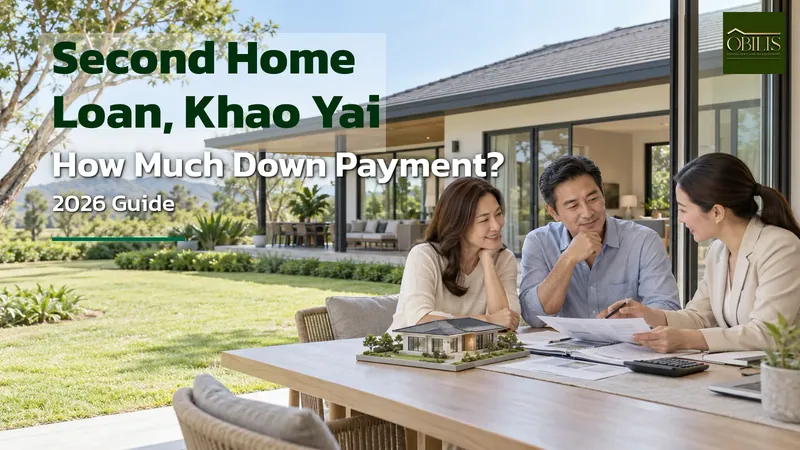
Second Home Loan in Khao Yai: How Much Down Payment Do Bangkok Buyers Need?
A second home loan for building in Khao Yai may still need your own down payment. The Bank of Thailand has extended its 100% LTV ceiling to June 30, 2027 for homes under 10 million baht from the second loan contract onward, but the announcement does not spell out self-build loans on your own land. Banks size those from land value and your BOQ, so confirm terms with your lender first.
- Thailand's relaxed LTV measure runs through June 30, 2027, per the Bank of Thailand.
- The 100% LTV ceiling applies to housing loans with collateral under 10 million baht, from the second loan contract onward.
- A self-build loan on your own land is sized by each bank from land value and your BOQ.
- Have your house plan and BOQ ready before applying so the bank can appraise accurately and move faster.
Second Home Loan Basics: How Khao Yai Financing Differs From Your First Home
A second home loan is how banks in Thailand classify financing for a property that isn’t your primary residence, whether you’re still paying off your first home or not. Many Bangkok buyers run into this exact question when they decide to build a vacation house on land they’ve bought near Khao Yai or Pak Chong.
Banks treat a second home as a slightly higher risk than a first home, because it isn’t the residence a borrower has to protect first if income gets tight. Lenders usually ask for stronger proof of income and look more closely at a borrower’s total debt load than they would for a first home loan.
The biggest practical difference is the loan-to-value ceiling, known as LTV, which Thailand’s central bank sets differently for second homes than for first homes. This ceiling determines how much cash you need upfront before a bank will even consider the loan. Foreign nationals generally cannot own land directly in Thailand, so this guide applies to Thai nationals financing a second home.
2026 LTV Rules for a Second Home Loan in Thailand
The Bank of Thailand (the country’s central bank) extended its relaxed LTV measure by another year, pushing the end date from June 30, 2026 to June 30, 2027 (source: Bank of Thailand, announced May 14, 2026).
Under this measure, loan contracts for residential property valued below 10 million baht, from the second loan contract onward, can be financed up to 100% of the appraised value. In practice, that means no extra down payment above the first-home standard during this window, provided the loan contract is signed while the measure is in effect (source: Bank of Thailand).
The catch is that this is a temporary measure tied to when the loan contract is signed, not a permanent right. Each bank still assesses a borrower’s repayment capacity on its own terms, so a bank can still ask for a larger down payment if it judges your existing debt load too high.
Building Your Own House on Your Own Land: Which Second Home Loan Applies
The Bank of Thailand announcement covers housing loans in general and does not spell out the case of building on land you already own. Building your own vacation house on land you already own near Khao Yai is a different case, because the collateral is vacant land plus a house that doesn’t exist yet. Banks instead size the loan around the appraised land value and the construction cost shown in your house plan and BOQ (Bill of Quantities, an itemized list of construction work and materials).
A self-build loan is usually disbursed in installments tied to construction progress, not as one lump sum like financing a finished home. You’ll need a finalized house plan and BOQ before applying, and the approved loan amount is based on the bank’s own appraisal of land plus structure, not the contractor’s quoted price.
Because the terms differ so much from buying a finished home, the down payment percentage you need to prepare yourself varies by bank and by your own financial profile. There’s no single percentage that applies across the board. Confirm the specific terms with the bank you plan to borrow from before you commit to land or sign a construction contract.
Documents to Prepare Before Applying for a Second Home Loan Near Khao Yai
The first set of documents covers proof of income and all existing debt, including whatever’s left on your first home loan. The bank calculates your combined monthly payment across both homes against your income to see whether you can realistically handle the extra load.
The second set covers the land itself: the chanote (the strongest form of Thai land title deed) or whatever title document the bank accepts, an approved or pending construction permit, and a BOQ from your designer or home-building company. This is what the bank uses to appraise collateral that doesn’t physically exist yet.
The third set, which Bangkok buyers often overlook, is your house registration document confirming your first home is still your primary residence. This affects whether the new loan genuinely qualifies as a second-home loan. Having all three sets ready before applying speeds up the bank’s review considerably.
Hidden Costs Bangkok Buyers Overlook With a Second Home Loan
The first overlooked cost is the land and construction appraisal fee, which banks usually charge separately from the loan processing fee, and sometimes charge again at each construction milestone since this is an installment-based loan.
The second is interest during construction. Many banks start charging interest on each disbursed installment immediately, even while the house is still unfinished. That means you’re carrying payments on your first home plus interest on the second home loan from the very first disbursement, long before you can actually move in.
The third is the cost of looking after the land and the half-built house when the owner isn’t on-site regularly, things like a perimeter fence to keep out trespassers or paying someone to check the site periodically. Budget for this from the moment you calculate your loan amount.
Work With a Team That Understands Khao Yai Before You Commit to a Second Home Loan
Financing a self-built second home involves more moving parts than buying a finished one, since it runs through land appraisal, house plans, BOQ, and installment disbursement all at once. Having a house plan and BOQ the bank can understand on the first read cuts down significantly on back-and-forth paperwork.
OBILIS prepares a house plan and BOQ for every homeowner before signing a construction contract, and it’s the same set of documents banks need for a self-build loan on your own land, regardless of which bank you borrow from. Complete documents with clear unit pricing tend to move through approval faster.
To get a rough idea of your budget, try the house budget planner, or contact the team to discuss the details.
Before you buy land or sign a construction contract, talk to the bank you plan to borrow from first to find out what you can realistically borrow, then size your house budget to match. That’s safer than fixing your house budget first and discovering later that the loan doesn’t cover it.
Related reading: Building a Second Home in Thailand: Ready-Made or Built on Land
Frequently Asked Questions
Do I need to finish paying off my first home before getting a second home loan?
Not necessarily. It depends on the bank’s own policy and your total debt load. Banks assess whether you can handle payments on both homes at once; if your income and other debts fall within an acceptable range, you can qualify for a second home loan while still paying off the first.
Does the 2026 LTV relaxation apply to a self-build construction loan?
The Bank of Thailand announcement does not single out loans to build on your own land. The amount you actually get still depends on each bank’s own appraisal of land and construction value, so confirm directly with your lender how the measure applies to a self-build case.
Should I have a house plan and BOQ ready before talking to a bank?
Yes. Banks use the house plan and BOQ to appraise a structure that doesn’t exist yet. Having this documentation ready from your first meeting helps the bank size your loan more accurately and cuts down on repeated rounds of paperwork revisions.
Key facts at a glance
| LTV relaxation period | July 1, 2026 to June 30, 2027 |
|---|---|
| LTV ceiling under the measure | 100% for homes under 10 million baht, from the 2nd loan contract onward |
| Self-build loan disbursement | Paid out in installments tied to construction progress |
| Key documents banks require | House plan, BOQ, and land title documents |
| Regulator | Bank of Thailand (BOT) |
| Construction-period interest | Often charged immediately on each disbursed installment |
Frequently asked questions
Do I need to finish paying off my first home before getting a second home loan?
Not necessarily — it depends on the bank's policy and your total debt load.
Does the 2026 LTV relaxation apply to a self-build construction loan?
The Bank of Thailand announcement does not spell out self-build loans, so check with each bank.
Should I have a house plan and BOQ ready before talking to a bank?
Yes, since banks use them to appraise a structure that doesn't exist yet.
When does a bank start charging interest on a construction loan?
Many banks charge interest on each disbursed installment immediately, even before the house is finished.