Sample House BOQ
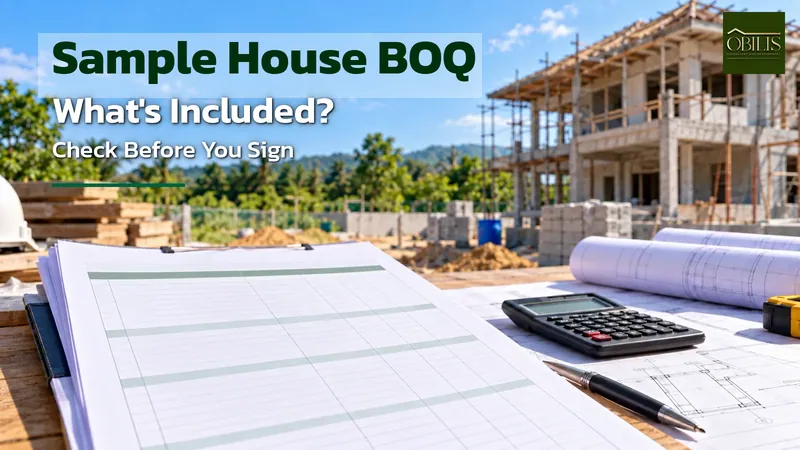
A sample house BOQ is a detailed table listing every construction item with its unit, quantity, unit price, and total cost, making it far more useful for comparing contractors than a quotation that only shows one final number. Ask your designer to prepare a master BOQ and have each contractor fill in their own unit prices on the same list. Items commonly missing include soil removal, pre-handover cleaning, and system testing fees.
- A house BOQ lists items, units, quantities, and unit prices clearly.
- Use one master BOQ so every contractor prices the same list fairly.
- A vague lump-sum line with no unit is a warning sign worth questioning.
- Soil removal, cleaning, and system testing fees often go missing from a first BOQ.
What Does a Sample House BOQ Actually Look Like
A sample house BOQ that actually works is a long table spanning several pages, not a single sheet that just states a total price. Each line in the table lists the item name, unit of measure, quantity, unit price, and the total cost for that item, all clearly separated. Some projects may run dozens of pages if the house has detailed finishing work, which is normal and not a sign of unnecessary paperwork.
Many people think a BOQ and a quotation are the same document, but a quotation only states the final number, while a BOQ shows where that number comes from in full. If you’ve never seen a real example before, it can be hard to picture how detailed it actually needs to be. Seeing a genuine example once helps you immediately judge whether the document from any given contractor is detailed enough.
Homeowners comparing quotes from multiple contractors should ask each one to show a sample BOQ from a previous project, to gauge how detailed that team’s documentation is before deciding who to hire. A contractor who runs their business properly usually won’t hesitate to show an old example, since it’s standard practice in this industry.
Categories Every House BOQ Must Include
A complete house BOQ is organised by category following the actual construction sequence — starting with site preparation and earthworks, then piling and foundations, the structural frame, roofing, walls and plastering, through to finished surfaces, doors and windows, sanitary fittings, electrical systems, plumbing systems, and painting as the final stage.
Each category needs a clear unit of measure — square metres for wall work, cubic metres for concrete work, or points for electrical work. If a category is written as a single lump sum with no unit, that’s a sign the quantities haven’t actually been broken down yet. Asking about a missing unit before signing is far easier than trying to fix it once work has already started.
Exterior work like fencing, the driveway, and extra land-filling is often separated from the main house BOQ and turns into an added cost later. Ask clearly from the start whether these items are included in the sample BOQ you’ve received.
Well-Written vs Loosely-Written BOQ Lines
A well-written line specifies materials clearly enough that someone else could go and buy them — for example, 60x60cm granite floor tiles, with brand and model specified, along with the exact square metres used, rather than just writing “grade A tiles”. The more clearly a line specifies detail, the less room there is for materials to be quietly swapped during construction.
A loosely-written line uses vague terms like “whole-house electrical system, lump sum” without stating the number of points, wire gauge, or breaker brand. When a problem arises later or you want to add a point, there’s no unit price to reference. Homeowners who spot a line like this should ask the contractor to break it down further before signing, rather than letting it slide because the overall total looks lower than a competitor’s.
The phrase “to standard” or “or equivalent” without specifying at least one reference brand is another point to watch closely, since materials described as “equivalent” almost always turn out to be the cheaper option once it’s time to actually purchase.
Using a Sample House BOQ to Compare Contractor Prices
The most effective method is to have your designer or home-building company prepare a neutral master sample BOQ with a complete list based on the plan, then send that same table to each contractor to fill in their own unit prices. This approach also lets homeowners without much construction knowledge compare prices fairly across every bidder.
When the items and quantities are identical across every bidder, differing price figures immediately become meaningful, because you know the difference comes from real unit pricing, not from one contractor cutting items or lowering specs differently than another.
Without a master sample BOQ to compare against, a price that’s several hundred thousand baht lower than a competitor’s doesn’t necessarily mean better value — it may simply mean certain items were quietly removed. Choosing the lowest bidder without comparing a full matching list is a risk that’s avoidable if you have a master document to check against.
Items That Commonly Go Missing From a Typical House BOQ
Site soil removal and pre-handover cleaning charges are two items that often don’t appear in the first version of a BOQ, only to be billed as extras close to handover. Ask upfront whether these two items are already included in the construction price or will be billed separately later.
Testing charges for electrical and plumbing systems before actual use, along with soil-boring test costs before piling on some projects, should also appear in the BOQ from the start, not surface later as separate add-on charges. Some companies already fold these costs into the overall construction price; asking clearly helps avoid misunderstandings between both sides.
Miscellaneous items such as temporary electricity meter installation, construction-site fencing rental, or construction insurance are sometimes left out because they’re seen as minor, but together they can add up to a meaningful amount. Ask clearly whether they’re already included in the price.
Always Ask to See the BOQ Before Deciding
Homeowners always have the right to ask for a sample BOQ before signing a contract, whether hiring a small independent contractor or a large home-building company, because this is the document that shows exactly what your millions of baht will actually be spent on. Asking to see this document isn’t a sign of distrust toward the contractor — it’s a standard step every homeowner should take.
The OBILIS team prepares a BOQ for every homeowner before work begins, and uses that same table to check progress through to handover day, so both sides reference the same set of figures throughout the project instead of arguing later about what was agreed. This approach reduces disputes during construction significantly, because both sides refer to the same document from start to finish.
If you want a rough figure for the house you have in mind, try the budget planner first, or contact us for advice based on your actual plan and land.
If a contractor you’re talking to has no sample BOQ to show at all, treat that as a warning sign worth considering carefully before agreeing on price or paying a deposit, since a homeowner’s negotiating power drops sharply once a contract is signed.
Frequently Asked Questions
Who should I ask for a sample house BOQ?
Normally you can ask the designer or home-building company that drew up the plan. If hiring an independent contractor directly, they should prepare one based on the plan they received. For extra neutrality, you can also hire an independent quantity surveyor to prepare a separate master BOQ.
Can I still hire a contractor without a sample BOQ?
You can, but the risk around change orders and progress inspection rises sharply, since there’s no unit price to reference when changes come up along the way. Try to obtain this document before signing a contract whenever possible.
Do I need to look at the house BOQ alongside the house plan?
Always look at them together, since the house plan only shows the look and dimensions, not what materials each part uses or how it’s priced. Holding both documents together helps you verify that on-site work matches what was actually agreed.
Key facts at a glance
| Core BOQ elements | Item name, unit, quantity, unit price, total cost |
|---|---|
| Main benefit | Comparing contractor prices and checking progress payments |
| Commonly missing items | Soil removal, pre-handover cleaning, system testing fees |
| Phrase to watch for | "To standard" or "equivalent" with no reference brand |
| Recommended comparison method | One master BOQ, each contractor fills in unit prices |
| Who prepares it | Designer, home-building company, or an independent quantity surveyor |
Frequently asked questions
Who should I ask for a sample house BOQ?
Normally the designer or home-building company that drew up the plan.
Can I hire a contractor without a sample BOQ?
Yes, but the risk around change orders and progress checks rises sharply.
Should I look at the BOQ and house plan together?
Always, since the plan shows looks and size but not materials or pricing.
What's the riskiest phrase to see in a BOQ?
"To standard" or "equivalent" without a reference brand, which usually means a cheaper substitute.