Grounding wire: is it necessary for a Khao Yai house?
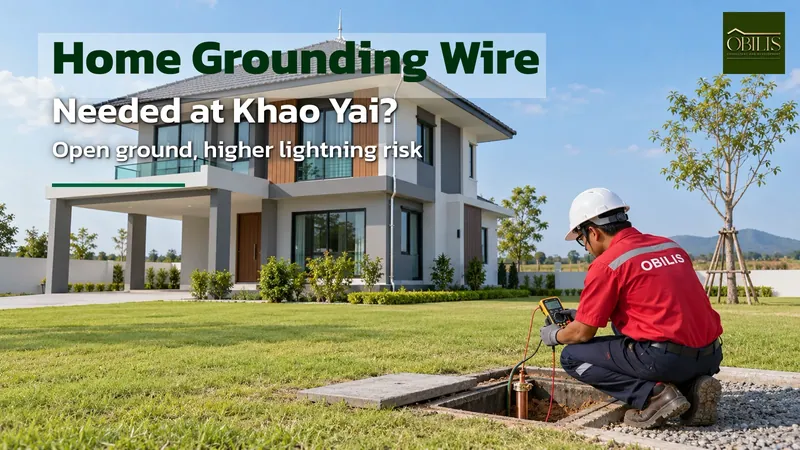
A grounding wire is necessary for every house, but it matters even more for a Khao Yai vacation home on open or elevated ground, since it faces higher lightning risk than a house in town. The EIT standard requires a ground rod at least roughly 2.4 meters long, with resistance not exceeding roughly 5 ohms or so (per EIT standard 022001-22). An unoccupied home should have this checked at least once a year.
- The ground rod must be at least roughly 2.4 meters long under the EIT standard.
- Ground resistance after driving must not exceed roughly 5 ohms or so.
- Houses on open or elevated ground around Khao Yai face higher lightning risk than houses in town.
- An unoccupied vacation home should have its grounding system checked at least once a year.
What Is a Grounding Wire, and Why Khao Yai Houses Need It More
A grounding wire (also called an earth wire) is a system connecting a house’s electrical circuits to a ground rod driven into the earth, so that leaking current discharges safely into the ground instead of passing through a person’s body. A house in a dense urban area surrounded by other buildings might treat this as low priority, but a vacation home on open or elevated ground in the Khao Yai area faces a different level of risk.
The Khao Yai and Pak Chong area sits on hilly, elevated terrain. A house standing alone with no tall structures nearby to share the risk is more exposed to lightning strikes than a house in town surrounded by other tall buildings. A properly installed grounding wire therefore matters more than usual for this kind of house.
This article explains what standard a grounding wire must meet, how it differs from a lightning protection system, and how a vacation home with no permanent occupant should maintain this system safely all year round.
What the Thai Electrical Standard Requires for a Grounding Wire
The Standard for Electrical Installation for Thailand, published by the Engineering Institute of Thailand (EIT, known in Thai as วสท.), requires a driven ground rod to have a diameter of at least roughly 16 millimeters and a length of at least roughly 2.4 meters or so (per the EIT standard 022001-22, consistently summarized across several electrical engineering sources).
After the rod is driven, the measured ground resistance must not exceed roughly 5 ohms or so to pass the standard and discharge leaking current effectively. The grounding conductor for a typical home should be no smaller than roughly 10 square millimeters or so (per the EIT standard 022001-22).
These figures are the general standard, but soil conditions vary by area. Dry, rocky soil common around Khao Yai can show higher ground resistance than moist soil in flat lowland areas, meaning some sites need more than one ground rod or a chemical treatment to lower the resistance further. Have an electrician measure the actual value on site rather than relying on estimates alone.
What Daily Risks Come from Having No Grounding Wire
Appliances with a metal casing, such as a water heater, refrigerator, or washing machine, can leave current sitting on the casing if the insulation degrades and there’s no grounding wire to carry it away. Anyone who touches the appliance at that moment risks an electric shock.
The Provincial Electricity Authority (PEA) treats grounding installation as part of the mandatory electrical safety standard for residential users, particularly for appliances that use water alongside electricity, such as water heaters, which carry a higher shock risk than ordinary appliances (per PEA’s electrical safety requirements).
A vacation home left closed for long stretches carries extra risk, since no one is around to notice anything unusual with the electrical system. If the grounding is incomplete or the ground rod has degraded over time, the problem may go unnoticed until someone actually stays there and an incident occurs.
Lightning Protection vs. a Grounding Wire: Are Both Needed
A grounding wire’s job is to discharge leaking current from household appliances into the ground. A lightning protection system, by contrast, is designed to intercept a direct lightning strike and route that current to ground before it damages the building’s structure. The two systems serve different purposes, even though both ultimately connect to a ground rod in a similar way.
An ordinary house in town may have a grounding wire without an additional lightning protection system, since nearby tall buildings help reduce the risk. But a standalone house or vacation home on a hill or open ground around Khao Yai or Pak Chong should consider adding lightning protection that follows the EIT standard and an international standard such as IEC 62305.
Whether additional lightning protection is actually needed should be decided by an electrical engineer who assesses the house’s position, the elevation of the area, and real lightning strike statistics for that location, rather than a decision based on feeling alone.
Maintaining the Grounding System at an Unoccupied Khao Yai Vacation Home
Owners of a vacation home with no permanent occupant should schedule an electrician to measure ground resistance at least once a year, since dry soil in the hot season can show higher resistance than during the rainy season, potentially failing the standard without the owner ever knowing.
Check that the grounding connection at the main distribution board is still secure, since humidity and insects common in the Khao Yai area can loosen connections or cause corrosion faster than in a house in town. Left unchecked, the grounding system can lose effectiveness without anyone noticing.
If the house has a smart alarm system or internet-connected security cameras, check that these devices are also properly grounded, since they’re often the first to fail from a power surge caused by a nearby lightning strike, even without a direct hit.
Install the Grounding Wire Correctly During Construction, Not After
Positioning the ground rod and running the grounding wire should happen during the structural and flooring stage of construction, since digging to bury a ground rod after the house is finished and the garden is landscaped is usually harder and can damage the landscaping already in place.
Have an electrician measure the actual ground resistance on site before closing up the structural work, rather than relying on calculations alone, since soil conditions vary from plot to plot around Khao Yai. Keep the measurement report as documentation for the final house inspection.
The OBILIS team pays particular attention to the grounding system for vacation homes in the Khao Yai and Pak Chong area, understanding the specific risks of elevated, open sites. Anyone planning to build in this kind of location should discuss grounding and lightning protection with the designer from the start.
To get a rough idea of your budget, try the house budget planner, or contact the team to discuss the details.
Frequently Asked Questions
Do I need both a grounding wire and a lightning protection system?
A grounding wire is a basic safety system every house should have. Lightning protection is an additional system worth considering for a house on open or elevated ground, such as a Khao Yai vacation home. Consult an electrical engineer to assess the site’s risk before deciding.
What ground resistance value counts as safe?
Under the EIT standard, ground resistance after driving the rod must not exceed roughly 5 ohms or so. If it measures higher, the electrician may need to add more ground rods or use a chemical treatment to lower the resistance further.
How often should grounding be checked at a vacation home left closed for long periods?
Schedule an electrician to check the ground resistance and the grounding connection at the main distribution board at least once a year, since humidity and seasonal soil changes can degrade the system without anyone noticing.
Key facts at a glance
| Ground rod size under the EIT standard | Diameter at least ~16mm, length at least ~2.4m or so |
|---|---|
| Maximum acceptable ground resistance | Roughly 5 ohms or so (per EIT standard 022001-22) |
| Grounding conductor size for a typical home | At least roughly 10 sq mm or so |
| Role of a grounding wire | Discharges leaking current from appliances into the ground |
| Role of lightning protection | Intercepts a direct lightning strike and routes it to ground |
| Recommended check frequency for an unoccupied home | At least once a year |
Frequently asked questions
Do I need both a grounding wire and a lightning protection system?
A grounding wire is a basic safety system every house should have. Lightning protection is worth considering for a house on open or elevated ground, like a Khao Yai vacation home.
What ground resistance value counts as safe?
Under the EIT standard, resistance after driving the rod must not exceed roughly 5 ohms or so. If higher, more ground rods or a chemical treatment may be needed.
How often should grounding be checked at a vacation home left closed for long periods?
Schedule a check of ground resistance and the main board connection at least once a year, since humidity and soil changes can degrade the system unnoticed.
What size must the ground rod be under the standard?
The EIT standard requires a diameter of at least roughly 16 millimeters and a length of at least roughly 2.4 meters or so.