Choosing a House Water Pump and Planning the System During Construction
A house water pump becomes necessary when public supply pressure is inconsistent, especially on a second floor or far from the pumping station. A pressure-tank pump is cheaper and suits homes that don’t use water at multiple points at once, while an inverter pump holds pressure steadier when several points run together. Pipe routes and tank position should be set on the drawings before the slab is poured, so nothing needs digging up later.
- A pump is needed when supply pressure is inconsistent, especially upstairs.
- A pressure-tank pump is cheaper; an inverter pump holds pressure steadier.
- Pump and tank size should be calculated for each house’s water points and pipe distance.
- Plan pipe routes and tank position on the drawings before the slab is poured.
Does Every House Need a Water Pump for Low Pressure
A house water pump has become essential for most homes today, because pressure in the public supply line is rarely consistent. At certain times of day pressure drops low enough that water barely trickles from the tap, especially on a second floor that’s at the far end of the pipe network or far from the pumping station, making upstairs water use inconvenient without a pump to boost pressure.
A single-storey house close to the pumping station may not need a water pump right away, but it’s still worth leaving the piping route and installation space ready in advance, because if you add a floor later or more people move in and water becomes insufficient, installing a pump later is far easier if the piping is already in place.
Before deciding on a pump, try checking the pressure from an upstairs tap during the times when the whole neighbourhood is using water at once, such as early morning before work or in the evening after everyone gets home, since that’s usually when pressure is at its lowest. If it’s still fine then, a pump may not be urgent yet.
How Many Types of House Water Pumps Are There, and How to Choose
House water pumps on the market are mainly split into pressure-tank pumps and inverter pumps that adjust motor speed to match actual water use. Pressure-tank pumps cost less and suit a house that doesn’t use water at multiple points at once, while inverter pumps suit a house with several points running simultaneously, such as more than one shower running at the same time, since they hold pressure steadier.
Choosing the right pump size is best done with a specialist or a pump retailer directly, since it depends on the number of water points in the house, the building’s height, and the pipe distance from the tank to the furthest point of use, all of which vary from house to house. There’s no single size that fits every home.
A house with a swimming pool or a garden watered by sprinklers should mention this to the pump supplier too, since a separate pump circuit for garden use may be needed, so pressure inside the house doesn’t drop whenever the garden irrigation runs at the same time.
Water Tank Size and Position to Plan During Construction
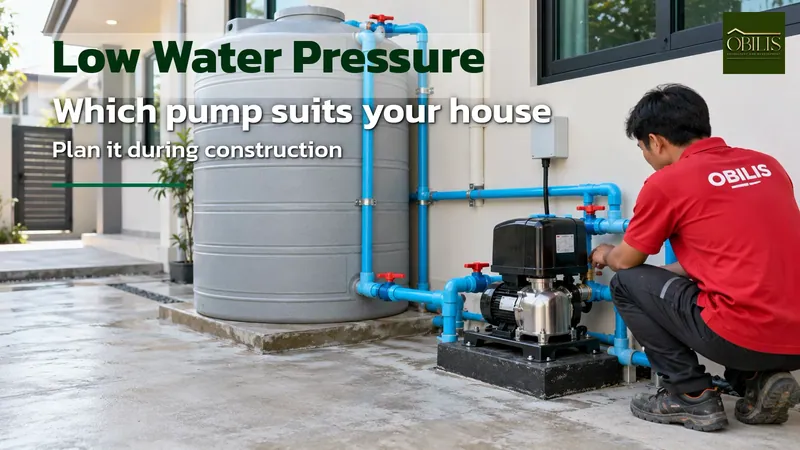
A water storage tank helps reserve water for when the public supply is cut off or pressure drops severely. The tank’s position should be somewhere a water delivery truck can reach easily in an emergency top-up, and not so close to the parking area that it risks being hit during everyday use.
The right tank size depends on the number of people in the household and each family’s water use habits. No single standard figure that applies to every house was found during this round of research, so it’s best to consult a tank supplier or plumbing designer to size it for your specific household.
The base supporting the tank needs to be poured solid enough to hold the weight of a full tank, since a tank that feels light when empty becomes much heavier once full. A base that isn’t strong enough can let the tank tilt or sink over time, so plan this together with pouring the yard or surrounding floor slab during construction.
Planning the Pipe System for a House Water Pump Before the Slab Is Poured
The pipe route from the water meter to the storage tank, and from the tank through the pump to each point of use in the house, should be set in the construction drawings from the start, so pipes buried in the ground or embedded in walls go in correctly the first time, with no need to dig up or demolish anything later once the house is finished.
A point that’s often overlooked is leaving separate shut-off valves for each zone of the house. If a pipe needs repair in the future, having valves split by zone lets you shut off water only to the area being repaired, instead of cutting water to the whole house, which is inconvenient for everyone at home.
Pipework connected to the pump should leave enough clearance for a technician to access it for future servicing or replacement, without needing to break into a wall or floor. Placing the pump in a reasonably open position reduces the cost of repairing or replacing the unit years down the line.
Backup Power and Noise: Problems That Show Up Later
A house water pump needs electricity to run. If the power goes out, the pump stops too, even with a full storage tank, since the pump is still needed to push water from the tank to each point of use. A house with frequent outages or in an area with unstable power should talk to an electrician about allowing for a backup generator circuit as well.
Pump noise is another issue homeowners often don’t think about at the planning stage, because a pump running at night can disturb a bedroom placed too close to the installation spot. Choose a pump position reasonably far from bedroom windows, or ask the supplier about an anti-vibration rubber base to reduce noise transmitted through the structure.
Checking the pump and tank regularly, following each manufacturer’s recommendations, matters because a pump’s lifespan and a tank’s condition vary depending on actual use in each household. Servicing on the schedule the manufacturer sets extends the equipment’s life far better than waiting for it to break before repairing it.
Plan Your Water Pump System With the Designer From the Start
A good house water pump, tank and piping setup needs to be thought through with the designer from the house planning stage, not left until the house is nearly finished and a plumber is called in to add it on. The tank position and pipe routes interact with structural and ground-level work done at the same time from the very beginning.
The OBILIS team plans the water tank, pump and piping positions on the construction drawings for every house from the design stage, so homeowners don’t need to retrofit the water system after moving in. Whichever team you build with, ask for these positions to be clearly marked on the construction drawings from the start.
To get a rough idea of your budget, try the house budget planner, or contact the team to discuss the details.
If your house is under construction and this hasn’t been discussed with the designer yet, raise it before the yard slab is poured or before pipes are buried underground, since this is the last point where positions can still be adjusted easily. After that, fixing it means digging up or breaking into finished structure.
Related reading: Septic Tank Size for a House in Thailand: What Does the Law Require?
Frequently Asked Questions
Does a single-storey house need a water pump?
Not always, if pressure from the public supply is already fine. But leave the piping route and installation space ready during construction, in case you need to add a pump later as pressure drops or the house is extended.
What’s the difference between a pressure-tank pump and an inverter pump?
A pressure-tank pump costs less and suits a house that doesn’t use water at multiple points at once. An inverter pump holds pressure steadier when several points run at the same time. Consult a specialist to choose based on your household’s actual water use.
Why is my house water pump noisy at night?
It’s usually because the pump is installed too close to a bedroom, or the base has no anti-vibration support. Choose a position away from bedroom windows and ask the supplier about an anti-vibration rubber base at installation.
Key facts at a glance
| When a pump is usually needed | Second floor, or far from the pumping station |
|---|---|
| Pressure-tank pump | Cheaper, suits homes without simultaneous multi-point use |
| Inverter pump | Holds pressure steadier with several points running together |
| When to plan pipe routes | Before the yard slab is poured or pipes are buried |
| Water tank size | No single standard; calculate for household size and usage |
| Cause of nighttime pump noise | Installed too close to a bedroom, or no anti-vibration base |
Frequently asked questions
Does a single-storey house need a water pump?
Not always, if public supply pressure is already fine. Leave the piping route and space ready in case one is needed later.
What’s the difference between a pressure-tank pump and an inverter pump?
A pressure-tank pump is cheaper and suits homes without simultaneous multi-point use. An inverter pump holds pressure steadier with several points running together.
Why is my house water pump noisy at night?
Usually because it’s installed too close to a bedroom, or the base has no anti-vibration support.
How do I choose the right water tank size?
No single standard figure applies to every house. Consult a supplier or plumbing designer to size it for your household’s people and usage.