no mains water in thailand planning a year-round supply
A house beyond the mains needs its own water system designed from the outset, with at least two sources. A borehole is the usual backbone and needs both a drilling permit and a water-use permit, plus a water test before any filter is bought. Allow roughly 200 litres per person per day, so a family of four wanting three to five days in reserve needs around 2,400 to 4,000 litres of storage.
- Keep at least two sources available, with a borehole as the backbone and rainwater as a supplement.
- Drilling needs both a drilling permit and a water-use permit, filed through a registered contractor.
- Test the water before buying filters, because Isan groundwater is often high in iron and manganese.
- Fix the tank, pump, filter and pipe positions before the ground floor slab is poured.
Off the Mains: What Water Sources Are Actually Available
A plot outside the mains water area does not mean a house without water; it means the owner has to design the water system from the very beginning. Many plots in Roi Et, on the outskirts of Korat and around Khao Yai and Pak Chong sit kilometres from the nearest main. This is something to check before you commit to the land rather than after the piles have gone in, and it is worth noting that foreigners generally cannot own land in Thailand, so the purchase structure needs proper legal advice of its own.
Five sources are realistically available: the Provincial Waterworks Authority (PWA), a village or Subdistrict Administrative Organization (SAO, known locally as the Or Bor Tor) supply, a borehole, surface water from a pond or canal, and rainwater. The simplest check is to telephone the local PWA branch office and ask where the nearest distribution main runs, because the cost of extending that main to your boundary falls on the applicant and is charged by distance.
Village or SAO water is cheaper and easier to connect, but pressure is often low and supply can stop for stretches during the dry season. A borehole is therefore still the backbone of most off-mains houses in Isan, with rainwater as a supplement for irrigation and washing down hard surfaces. The rule that holds everywhere is to have at least two sources available.
Drilling a Borehole: Survey, Permits and Water Testing
Before drilling, survey what already exists around you. Ask neighbours how deep their boreholes are, whether the flow holds up all year, and how far the yield drops in the dry months. Then request aquifer data from the regional groundwater resources office or the provincial natural resources and environment office. Depths vary enormously: some plots strike water at around 30 metres, others have to go past 100.
Drilling and using groundwater is regulated under Thailand’s groundwater legislation, and you need both a drilling permit and a water-use permit from the responsible provincial authority. Conditions and fees vary by zone and by the volume you intend to draw, with stricter requirements where extraction is already heavy. Check with the local office before starting work in 2026, and use a properly registered drilling contractor.
Once you have water, resist the urge to go straight out and buy a filter. Send a sample for testing first. Groundwater across many districts of Roi Et and Korat is high in iron and manganese, which turns the water cloudy and rust-red when it stands and leaves stains on sanitary ware. Some sources are very hard, others carry salinity. The test results tell you what genuinely needs filtering, which is far cheaper than buying filter vessels by trial and error.
How Big Should the Storage Tank Be to Last the Year?
The simple rule of thumb is roughly 200 litres per person per day for an ordinary home, so a family of four uses around 800 litres a day. If you want three to five days in reserve against power cuts, pump failure or a borehole that is yielding less than usual, you are looking at roughly 2,400 to 4,000 litres of capacity. A lawn or a garden adds a good deal on top of that.
Above-ground tanks are cheaper, easy to inspect and easy to clean, but they take up space and must be an opaque model to keep algae out. Underground tanks hold more and keep the water cooler, but they need a proper base and protection against groundwater pressure, and they are harder to clean. Remember that 1,000 litres of water weighs about a tonne, so the tank base must be concrete designed for that load, not simply a patch of compacted fill.
Houses on borehole water should keep the raw-water tank separate from the treated-water tank, so sediment settles out in the first before anything reaches the filters. Rainwater is best stored in a third set and used for watering plants and washing down. Holiday houses around Khao Yai that are occupied only in spells should hold more than the standard reserve, since nobody is there to watch the system day to day.
Pumps and Pressure Tanks: Getting Strong Flow at Every Outlet
Most off-mains systems use two pumps. The first is a submersible unit that lifts water from the borehole up to the storage tank. Size it to the depth of the bore and its measured yield rather than to the biggest horsepower on the shelf, because an oversized pump simply draws the bore dry and shortens its own working life in the process.
The second pump pushes water from the tank into the house. A single-storey house with one or two bathrooms is perfectly well served by a standard automatic pump. A two-storey house with several bathrooms and rain showers does better with a constant-pressure or inverter pump, because the pressure stays steady when several outlets are running at once.
A pressure tank reduces the rapid on-off cycling that kills pumps well before their time. Check the air pressure in the tank once a year and keep it just below the pump’s cut-in pressure. Site the pump in the shade under a roof with decent ventilation, because a pump left standing in the sun and rain has a visibly shorter life than one kept sheltered.
Filtration, Softening and Getting the Pipe Routes Right Before the Slab
A basic set-up for an Isan house on borehole water usually starts with a media filter for iron and manganese, followed by a carbon vessel for odour and colour, then a fine cartridge filter before the water enters the house. If the test shows high hardness, add a resin softener, which needs salt top-ups and backwashing on a schedule. Drinking water is best handled by a separate reverse-osmosis unit at the point of use.
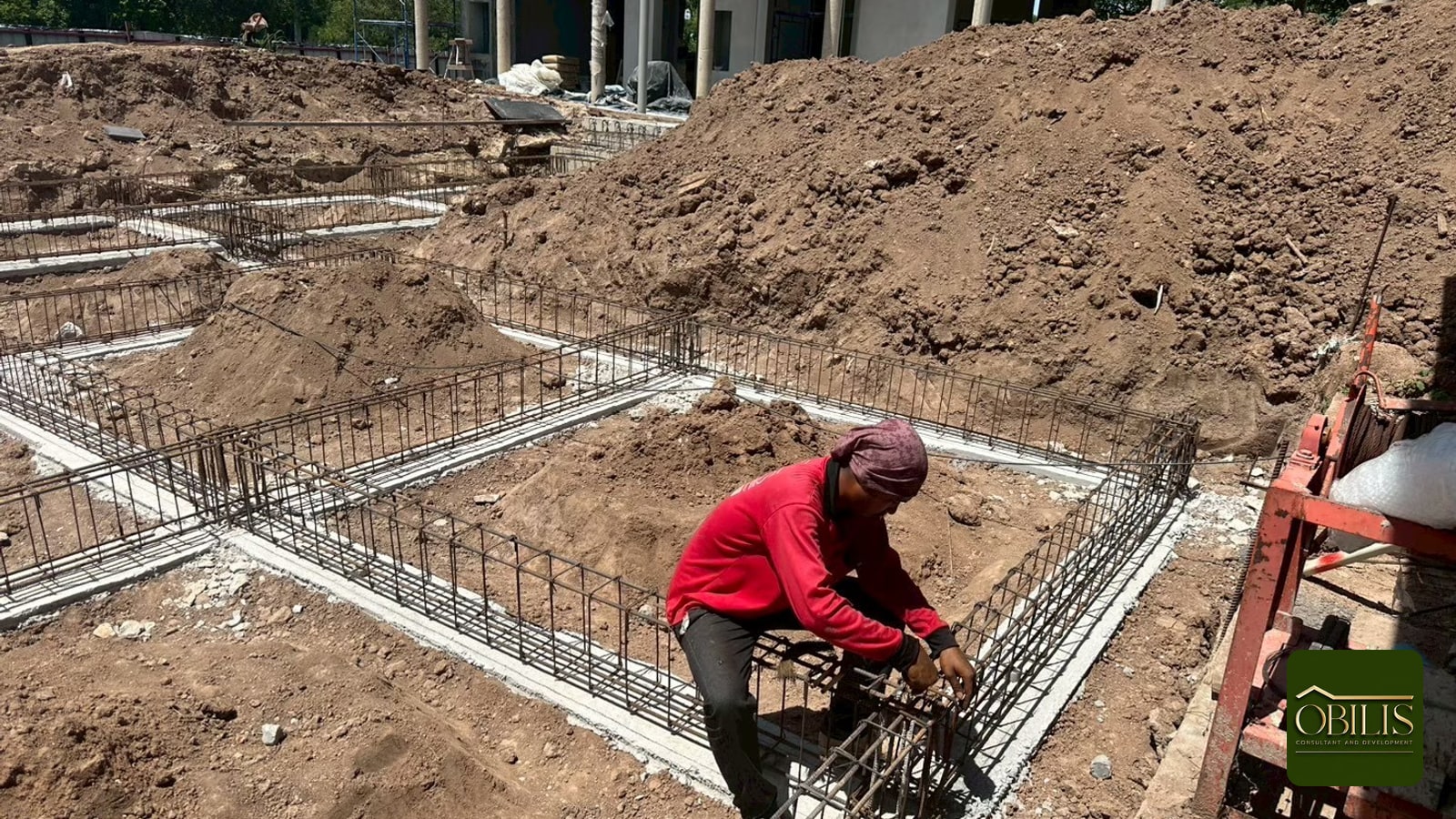
What people most often forget is the layout itself: where the tank, pump and filter train will physically stand. That has to be fixed at design stage rather than improvised later, because the equipment takes up real space, carries several pipe runs in and out, and needs a drain for backwash water. Once the positions are settled, the sleeves through the ground beams and the conduit for the pump’s power supply can be set correctly before the slab is poured.
Draw the supply and waste pipe routes for the whole house and walk through them with the crew before the ground floor slab goes down, because after the pour any change means breaking concrete. Avoid burying joints under the slab, fit an isolating valve for each bathroom so a repair does not mean shutting off the whole house, and run pipework now for the garden taps you will certainly want later.
Planning for the Dry Season and Budgeting for an Off-Mains House
The Isan dry season is the real test of any water system. Between March and May the water table drops, and a borehole that yielded well may give less or come up cloudy. The way to handle it is not to pump continuously but to run the pump in timed intervals so the bore can recover, backed by enough stored water to bridge those recovery periods comfortably.
On budget, the following figures are only a rough frame. A borehole with casing and a submersible pump for a house typically falls somewhere around 40,000 to 120,000 baht depending on depth and on the soil and rock layers encountered. Storage tanks with a base and a delivery pump come to roughly 20,000 to 50,000 baht, and an iron-removal filter train plus a drinking water unit to roughly 20,000 to 60,000 baht. All of this shifts with location, brand and timing, so always obtain real quotations.
What helps most is building the water system into the house design from the outset rather than treating it as a job to hire out afterwards. OBILIS teams ask about the water source and the borehole position before any drawing is started, because the tank, the filters and the pipe routes affect both the floor plan and the foundation work. A few weeks of planning ahead saves a great deal in concrete-breaking and relocation costs later on.
To get a rough budget before you talk to anyone, try our house price calculator, or contact the OBILIS team to talk through your plot.
Related reading: Temporary Electricity and Water for Construction in Thailand
Frequently Asked Questions
Do I need a permit to drill a borehole?
Yes, both a drilling permit and a groundwater use permit, filed with the provincial groundwater authority. Conditions and fees vary by area and by how much water you intend to use. Have a registered drilling contractor handle the filing for you and keep the complete set of documents on file.
Is a 2,000-litre tank enough for a family of four?
It covers about two and a half days of normal use and no more. For a genuine reserve during a power cut or a pump failure, aim for roughly 3,000 to 4,000 litres in total. Two 2,000-litre tanks plumbed in parallel work well and are easier to maintain than a single large tank.
Our groundwater is rust-red and leaves stains. What fixes it?
That is almost always iron and manganese. The remedy is aeration followed by a media filter using the appropriate filtration medium, backwashed on a set schedule. Have the water tested first so the medium is matched to the levels actually present in your supply.
ข้อมูลสำคัญโดยสรุป
| Water use per person | approximately 200 litres per day |
|---|---|
| Storage for four people, 3 to 5 days reserve | roughly 2,400 to 4,000 litres |
| Borehole depth | around 30 metres on some plots, past 100 on others |
| Borehole with casing and submersible pump | approximately 40,000 to 120,000 baht |
| Tanks with base and delivery pump | roughly 20,000 to 50,000 baht |
| Filter train plus drinking water unit | roughly 20,000 to 60,000 baht |
คำถามที่พบบ่อย
Do I need a permit to drill a borehole?
Yes, both a drilling permit and a groundwater use permit, filed with the provincial groundwater authority. Conditions and fees vary by area and by how much water you intend to use. Have a registered drilling contractor handle the filing for you and keep the complete set of documents on file.
Is a 2,000-litre tank enough for a family of four?
It covers about two and a half days of normal use and no more. For a genuine reserve during a power cut or a pump failure, aim for roughly 3,000 to 4,000 litres in total. Two 2,000-litre tanks plumbed in parallel work well and are easier to maintain than a single large tank.
Our groundwater is rust-red and leaves stains. What fixes it?
That is almost always iron and manganese. The remedy is aeration followed by a media filter using the appropriate filtration medium, backwashed on a set schedule. Have the water tested first so the medium is matched to the levels actually present in your supply.
What happens when the borehole yields less in the dry season?
Between March and May the water table drops and a borehole that yielded well may give less or come up cloudy. Do not pump continuously; run the pump in timed intervals so the bore can recover, and keep enough stored water to bridge those recovery periods comfortably.