
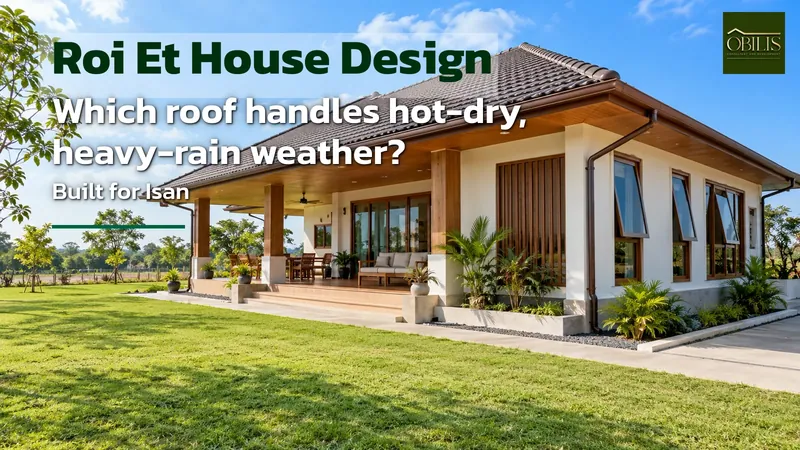
Roi Et House Design: Which Roof and Orientation Handle the Hot-Dry, Heavy-Rain Climate?
A Roi Et house design that is comfortable needs a gable or hip roof with a reasonably steep pitch to drain heavy rain fast, eaves projecting roughly 80-100 centimeters to block afternoon sun and rain splash, and low-use rooms placed on the west side as a heat buffer. Roi Et averages roughly 1,300-1,400 millimeters of rain per year, and that has to shape the design from the start.
- Gable or hip roofs drain heavy rain faster than flat roofs
- Eaves projecting roughly 80-100 centimeters block sun and rain splash
- Open windows toward the southeast and northeast to catch natural wind
- Lightweight concrete block walls and reflective paint cut cooling costs long-term
Roi Et House Design Starts With Understanding Its Hot, Dry-Then-Heavy-Rain Climate
Roi Et house design that actually feels comfortable has to start from the local climate, not a template borrowed from another province. Roi Et sits in central Isan (northeastern Thailand), with scorching heat in the dry season and rain that concentrates heavily in just a few months. Average annual rainfall is roughly 1,300-1,400 millimeters (approximately), falling mostly within a short rainy window, so a house has to cope with both heat buildup and sudden heavy rain in the same season.
Heat buildup in Isan mostly comes from long hours of direct sun each day. Walls and roof slopes facing west absorb heat that radiates into the house all afternoon. If a Roi Et house design does not shield that side from the start, the owner ends up relying on air conditioning more and more every afternoon.
Heavy rain in Roi Et tends to fall hard over short bursts rather than drizzle all day. Houses without long enough eaves end up with rain splashing onto windows and walls, which stay damp and grow mold over time. A Roi Et house design has to answer both problems together, not patch them one at a time after move-in.
Which Roof Works Best for a Roi Et House Design Facing Hot-Dry, Heavy-Rain Weather
A gable or hip roof with a reasonably steep pitch works well here, since the slope lets heavy rain drain fast instead of pooling on the roof sheets. At the same time, the gable’s vented gap helps release some of the heat trapped under the roof.
Roofing material matters too. Concrete or ceramic tiles hold more heat than coated metal sheets, but tiles handle rain noise better; metal sheets are lighter but need extra insulation underneath to cut down on heat and noise coming through.
Whatever the material, a Roi Et house design needs heat-blocking insulation under the roof and vents at the ridge. Without a way for the hot air under the roof to escape, that heat slowly radiates down into the upper-floor ceiling all night long.
Eaves and Orientation: The Overlooked Fix for Both Heat and Rain Splash
Eaves projecting roughly 80-100 centimeters (approximately) block both afternoon sun and rain splash at the same time. Many houses across Isan built without this end up bolting on extra awnings later, which works but never looks as clean as designing it in from the start.
Orientation matters just as much. The west and south sides take the harshest afternoon sun. Placing low-use rooms like storage or a staircase on that side acts as a buffer, keeping heat from hitting bedrooms or the living room directly.
The side that opens to catch natural airflow should face where the wind actually travels. Roi Et is landlocked, with prevailing breezes from the southeast during the rainy season shifting to the northeast in the dry season. Opening windows on both of these sides lets a house ventilate itself without leaning on air conditioning around the clock.
Wall and Floor Materials That Suit a Roi Et House Design Long-Term
Lightweight concrete block walls hold less heat than traditional clay brick and insulate better on their own, which suits the sustained heat of an Isan summer. Clay brick is still popular because local labor and material costs are more familiar to area contractors.
A ground floor raised slightly above the original soil level helps keep out moisture from accumulated rain. Some low-lying parts of Roi Et near open rice fields can pool water during several days of continuous heavy rain, so raising the floor level is an upfront investment that pays off far more cheaply than fixing water damage later.
Exterior paint with heat-reflective properties genuinely lowers wall surface temperature on sunny days. It costs slightly more per liter than standard paint, but it cuts the air-conditioning load year-round, making it worth budgeting for at the material-selection stage.
Covered Porches and Buffer Zones That Help a House Handle Heavy Rain
A roofed porch or veranda acts as a buffer zone between outside and inside, keeping rain from splashing straight onto doors or large windows, while also giving a shaded spot to sit out the afternoon heat.
Large glass sliding doors without a covering porch in front tend to get rain-streaked often. A Roi Et house design that places a covered porch in front of these openings cuts down on glass-wiping and reduces moisture buildup around the frame edges.
A gentle slope in the paving around the house, angled slightly away from the structure, drains rainwater instead of letting it flow back toward the house. This detail is often overlooked in generic house plans that were not designed with Isan’s rainfall volume in mind.
Choose a Roi Et House Design With a Team That Knows the Area
A design that looks great in a brochure does not guarantee comfort in Roi Et specifically, since climate, wind direction, and rainfall vary across different Isan provinces. A team with real build experience in the area knows exactly where to adjust from a standard plan.
OBILIS is one of the home-building teams that has worked continuously across Isan, adjusting house design details to the real climate of each site, from roof pitch down to the eave length suited to that location’s rainfall.
To get a rough idea of your budget, try the house budget planner, or contact the team to discuss the details.
Before choosing a Roi Et house design from anywhere, ask the design team directly whether they have already adjusted for the site’s actual sun direction, wind, and rainfall. That detail decides whether you will be comfortable for decades or stuck fixing the same problems in year one.
Related reading: Building Permit for a Roi Et House: Where to Apply and What Documents Do You Need?
Frequently Asked Questions
What roof shape works best for a Roi Et house design?
Gable and hip roofs with a reasonably steep pitch are the most common choice, since they drain heavy rain quickly and the gable vent helps release trapped heat. Flat roofs do not suit an area with Roi Et’s concentrated heavy rainfall as well.
How far should the eaves project to be enough?
Eaves projecting roughly 80-100 centimeters (approximately) work for most houses. On open land facing the harsh west sun directly, you may need a longer projection or an additional covered porch.
Can you build during Roi Et’s rainy season?
Yes, but the structural and roofing work should be planned to finish before the heaviest rain months, to reduce the risk of water pooling in concrete pours or damaging certain materials before they are properly installed.
Key facts at a glance
| Average Roi Et rainfall | Roughly 1,300-1,400 mm/year (approximately) |
|---|---|
| Best roof shape | Gable or hip, reasonably steep pitch |
| Recommended eave length | Roughly 80-100 cm (approximately) |
| Hottest-facing side | West and south in the afternoon |
| Recommended wall material | Lightweight concrete block, better insulation than clay brick |
| Flood-risk spot | Low-lying land near open rice fields |
Frequently asked questions
What roof shape works best for a Roi Et house design?
Gable and hip roofs with a reasonably steep pitch are most common, since they drain heavy rain quickly and release trapped heat.
How far should the eaves project to be enough?
Eaves projecting roughly 80-100 centimeters (approximately) work for most houses; open land facing harsh west sun may need more.
Can you build during Roi Et's rainy season?
Yes, but structural and roofing work should finish before the heaviest rain months to avoid water damage.
When does Roi Et get the most rain?
The heaviest rain typically falls mid-to-late in the year, toward the end of the rainy season.