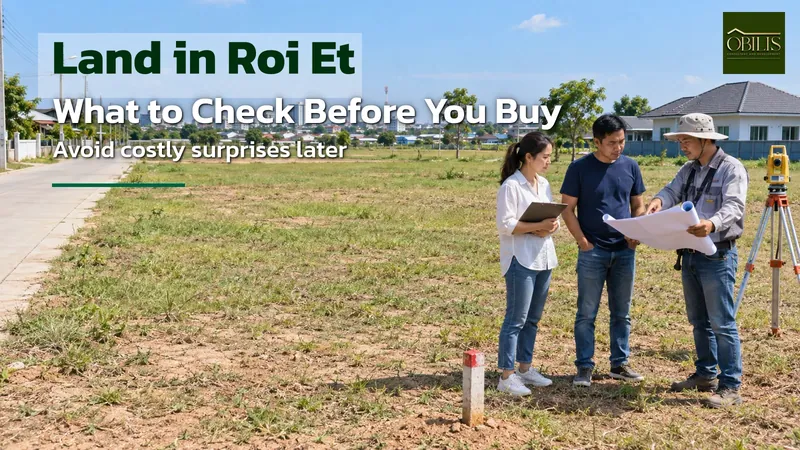
What to check before buying land for a house in Roi Et
Before buying land for a house in Roi Et, check whether it sits in town, on the edge of town, or in an outer district, since that affects electricity and water extension costs. Verify the land title at the Land Office, check the town plan allows the house you want, confirm legal access, and inspect the site during rainy season for flood risk.
- Compare in-town, edge-of-town, and outer-district land based on how you plan to use the house.
- Verify the land title and town plan at the Land Office and local government office.
- Check whether the plot has legal access or is landlocked.
- Ask the electricity and water authorities whether a service extension is needed.
Buying Land for a House in Roi Et: Why Location Matters More Than You Think
People planning to move back and build a house in Roi Et, or anyone shopping for a new plot, usually focus first on the price per rai (a Thai land unit, about 1,600 square meters). But the location of land for a house in Roi Et actually drives long-term costs more than the initial land price, because a plot far from a main road or far from electricity and water lines comes with several hidden costs down the line.
Before deciding, ask a simple question first: will the house be for yourself, for your parents, or to rent out later? The answer determines whether you should be looking in town, on the edge of town, or in an outlying district, since each zone has clearly different trade-offs. There is no single right answer for everyone.
This article breaks down land for a house in Roi Et into three main zones: inside the municipal area, just outside the municipality but still an easy commute to town, and the outer districts further out. Each zone has different things worth checking before you decide.
In-Town Roi Et Land vs. the Edge of Town: What’s the Difference
Land inside the Roi Et municipal area usually costs noticeably more per square wah (a smaller Thai land unit, about 4 square meters) than land further out, in exchange for ready electricity, water, paved roads, and shorter distances to hospitals and schools. This suits anyone who wants aging parents close to amenities.
Land just outside the municipality but still close to town is often the sweet spot for people wanting more space at a more affordable price. Still, check whether electricity and water actually reach the plot already, or whether a service extension is needed, since some spots not far from town still lack a nearby power line.
Also worth checking is whether the area’s comprehensive town plan fully permits residential construction or carries restrictions on building footprint, since some edge-of-town zones fall under a planning color that is not ideal for a larger house.
Outer-District Land in Roi Et: Cheaper, But Check These Extra Points
Land in Roi Et’s outer districts is usually much cheaper per rai than in town, suiting anyone who already has inherited land or wants more space for farming alongside the house. But that value comes with conditions worth studying first.
The first thing to check is the distance from the plot to the nearest power pole. If it’s too far, you may end up responsible for all or part of the cost of extending the electrical line, an expense people often forget to budget for when pricing out land.
The second is road condition leading to the plot. A gravel or dirt road that an ordinary car can handle may not support a concrete mixer truck or large material delivery trucks during the rainy season. This is worth checking in person or asking locals, not just looking at an online map.
Check Land Title Documents and Zoning Before Buying Land in Roi Et
Whichever zone you choose, the land title document is something to check before putting down any deposit. Some plots in Roi Et are still held under a possessory right certificate rather than a full chanote title deed, and these come in a version surveyed with aerial photographs and one without, each with different transfer rules and legal conditions.
Get a copy of the title document and verify it yourself at the local Land Office, confirming the seller’s name matches the document, there are no liens or mortgages attached, and the plot is not under dispute. This step should never be skipped, even when buying from someone you know.
Beyond the title document, check the provincial comprehensive town plan to see which zoning color the plot falls under, since some zoning colors carry stricter building size or setback requirements. Ask the provincial Public Works and Town Planning office or the local SAO before deciding.
Access Roads and Utilities: The Most Common Mistakes
Land that looks great in photos may not actually have legal public access. Some plots require crossing someone else’s land to reach the main road, known as landlocked or semi-landlocked land. Without a properly registered right-of-way easement, this can lead to disputes with neighboring landowners later.
Water supply matters just as much. Land outside the Provincial Waterworks Authority (PWA) service area may need to rely on a groundwater well or rainwater storage instead, which comes with different costs and upkeep than a direct water connection. Check with the local PWA office in advance about whether a meter can be issued.
Before buying, walk the plot during the rainy season if at all possible to check for standing water, since some areas in Roi Et sit near rivers or low-lying floodplains that flood seasonally, which would affect the foundation design and floor level of the future house.
Final Checks Before Closing on Land for a House in Roi Et
Once satisfied with location, title, and utilities, the final step before a deposit is to sketch a rough house layout on the actual plot, checking whether the size and shape of the land suit the intended house design, including setback distances required under the Building Control Act.
Where possible, consult a designer or home-building company to assess the land before committing to a purchase, since land that looks fine to a layperson may carry structural limitations that add cost later, such as needing extra fill or deeper piling than expected.
The OBILIS team regularly advises clients across the Isaan region on choosing land alongside house design. Anyone shopping for land for a house in Roi Et who is still unsure whether a particular plot is suitable should consult a specialist before putting down a deposit.
To get a rough idea of your budget, try the house budget planner, or contact the team to discuss the details.
Frequently Asked Questions
Should I buy land for a house in Roi Et in town or on the outskirts?
It depends on your purpose. If you want convenience near hospitals and amenities for elderly parents, in-town land fits better. If you want more space at better value and travel isn’t an issue, land just outside the municipality is usually the better long-term buy.
Can I build on landlocked land in Roi Et?
Yes, if a right-of-way easement is properly registered by law. If it isn’t registered yet, negotiate with the neighboring landowner first, since this can affect both the building permit and the future house registration.
Land outside the water utility area — how do I get water?
Most owners drill a groundwater well or add a rainwater storage system. Check with the local Provincial Waterworks Authority office in advance about any plans to extend service to that plot before deciding to buy.
Key facts at a glance
| Three main zones for Roi Et land | Inside the municipality, just outside it, and the outer districts |
|---|---|
| What to check before a deposit | Land title, town plan, access, and electricity/water systems |
| Risk with landlocked land | A right-of-way easement must be properly registered by law |
| Water options outside the utility area | A groundwater well or rainwater storage system |
| Risk with outer-district land | Long distance to power poles and roads unable to handle material trucks in the rainy season |
| Final step before closing | Sketch a rough house layout on the plot and check setback distances under the Building Control Act |
Frequently asked questions
Should I buy land for a house in Roi Et in town or on the outskirts?
It depends on purpose. In-town land suits convenience near amenities, while land just outside the municipality usually offers better long-term value for more space.
Can I build on landlocked land in Roi Et?
Yes, if a right-of-way easement is properly registered by law. If not yet registered, negotiate with the neighboring landowner first.
Land outside the water utility area, how do I get water?
Most owners drill a groundwater well or add rainwater storage. Check with the local water authority in advance about service extension plans.
What should I watch out for with cheaper outer-district land?
Check the distance to the nearest power pole and the road condition, since you may have to pay for electrical line extension and the road may not handle material trucks in the rainy season.