
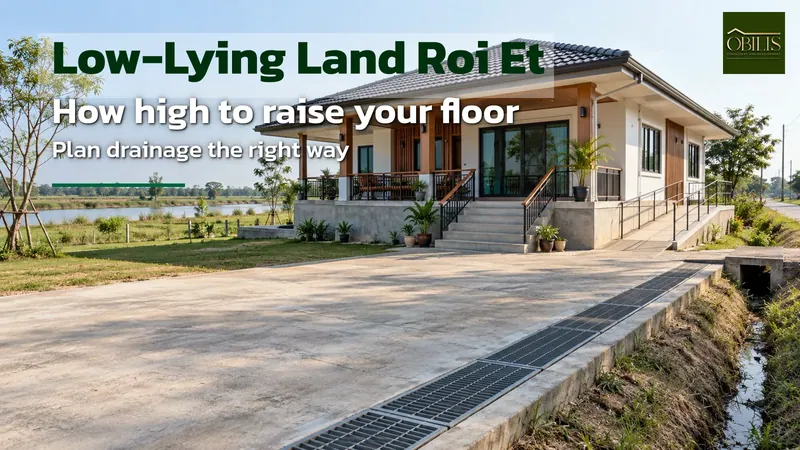
How High to Raise the Floor and Plan Drainage
A house on low-lying land in Roi Et should have its floor raised approximately above the highest flood level ever recorded at that specific site; there is no single fixed height for every plot. A soil boring test is important before designing the foundation, since low-lying land often has soft soil layers, and drainage should always slope away from the house with a floodgate to stop water flowing back in.
- Raise the floor approximately above the highest recorded flood level, not a fixed universal number.
- The Lam Nam Yang basin in Selaphum district has flooded repeatedly in recent years and should be checked before buying land.
- A soil boring test matters more here since low-lying land often has soft soil.
- Drainage should slope away from the house, with a valve to stop water flowing back in.
What to Know Before Building on Low-Lying Land in Roi Et
Building a house on low-lying land in Roi Et carries different risks than building in town or on higher ground, because low-lying plots usually sit near a waterway or on a flat field that collects runoff from higher ground during the flood season. The main risk isn’t just water entering the house, but soil that stays saturated long enough to affect the foundation’s strength.
Buyers often notice that land in this zone is cheaper than higher ground in town, but forget to budget for the extras that come with it: raising the floor higher than usual, extra land filling, and a drainage system around the house that needs to be better than average. Added together, these can eat up most of the savings from the lower land price. Note that foreign nationals generally cannot own land in Thailand directly, so this guide is written for Thai nationals and for foreigners planning to build through a Thai spouse or another legal structure recognised under Thai law.
Before buying land in this zone, ask locals or the Sub-district Administrative Organization (SAO, the local government office) which years the plot has flooded and how high the water reached, since long-time residents’ accounts are usually far more reliable than how the land looks on a dry day when you happen to visit.
Which Parts of Roi Et Count as Flood-Prone Low Land
The Lam Nam Yang in Selaphum and Phon Thong districts has overflowed its banks and flooded farmland and homes in several recent years, according to news reports and warnings from Thailand’s Department of Disaster Prevention and Mitigation. Buyers should ask locals about a plot’s flood history before deciding.
The affected area is mainly in Selaphum and Phon Thong districts. If you’re considering land in this zone, check the plot’s position relative to any flood barrier carefully, since land inside versus outside the barrier can carry very different levels of risk.
Beyond the Lam Nam Yang basin, several districts along the Chi River in Roi Et have similar flat, flood-collecting terrain. If the land you’re interested in sits near the Chi River or a secondary waterway, it’s worth asking the local irrigation office about drainage patterns in recent years.
How High Should You Raise the Floor on Low-Lying Land in Roi Et
Thailand’s Building Control Act sets out general principles for flood protection across several ministerial regulations, but it doesn’t fix a single floor-raising height for every area, since the highest flood level differs by location (source: Building Control Act, Department of Public Works and Town & Country Planning). The right height for each plot should be based on the highest flood level actually recorded there, not a number copied from somewhere else in the province.
The practical approach is to ask locals or local authorities for the highest flood level on record, then have a structural engineer set the floor level approximately above that recorded level, with a small additional safety margin, rather than guessing or copying a figure used elsewhere that may not match this plot at all.
A raised stilt house, a traditional style long used across Isan, is another option for low-lying Roi Et land, since it lifts the entire living space above flood level rather than raising only the beams. The benefit is extra usable space underneath for storage or parking, but the structural cost is higher than a house built at normal floor level, so have the designer calculate whether it’s worth it before deciding.
Planning Drainage So Water Doesn’t Flow Back Into the House
Drainage around a house on low-lying Roi Et land needs to be planned separately from the household wastewater system from the start, because the large volume of rainwater during flood season needs a clear path out, rather than being allowed to pool around the house and seep under the foundation. Grading the drainage channels around the house to slope away from the building at all times is a basic principle that shouldn’t be skipped.
Collection pits and drains connecting to a public canal or waterway need a valve or floodgate to stop water flowing back in when the outside water level rises above the drain, because without this safeguard, canal water can flow backward into the house’s own drainage system at the peak of a flood.
Filling the ground around the house slightly higher than the surrounding area, combined with a clear drainage path, reduces risk far more reliably than depending on a pump alone once the water has already arrived, since a pump needs continuous electricity for as long as the water stays high, a condition you can’t count on during an actual flood.
Does the Foundation for Low-Lying Land Need a Soil Boring Test
Land in low-lying zones usually has soft soil layers built up from years of flood sediment, which makes guessing pile depth from a neighbouring house riskier than on higher ground. A soil boring test before designing the foundation matters more than usual here, because it lets the engineer set a pile depth that actually matches that plot’s soil, neither too deep (wasting budget) nor too shallow (risking settlement).
A house built on newly filled land in a low-lying zone should also be checked for whether the fill has had enough time to settle. Piling into fill that hasn’t fully settled yet can cause the ground around the house to sink at a different rate than the house itself, which stands on piles, creating an uneven joint between the filled ground and the structure over time.
The cost of a soil boring test is minor compared with the damage that can result if the foundation doesn’t match the real soil conditions. Homeowners building on low-lying land in Roi Et shouldn’t skip this step just to save a small amount of time or money upfront.
Choose a Designer Who Understands Low-Lying Land in Roi Et
Building on low-lying land in Roi Et needs a designer and contractor who have handled this kind of site before, because floor-raising height, pile depth and drainage all have to be calculated together from the very first draft of the plan, not added on as an afterthought once the design is already finished.
The OBILIS team assesses the actual site condition before designing every house, including houses on low-lying land in Roi Et, so the house plan and foundation match the real conditions of that plot. Whichever team you work with, insist on an actual site visit before the design work begins.
To get a rough idea of your budget, try the house budget planner, or contact the team to discuss the details.
One thing worth getting in writing is who is responsible if the ground around the house settles unevenly in the first year after moving in, since newly filled low-lying land is more prone to this than normal higher ground. Agreeing on this upfront helps avoid disputes later.
Frequently Asked Questions
How high should I raise my floor when building on low-lying land in Roi Et?
There’s no single fixed number for every plot. Check the highest flood level actually recorded at that location first, then have an engineer set the floor approximately above that level, with an additional small safety margin.
Is a raised stilt house a good fit for low-lying land in Roi Et?
Yes, because it lifts the entire living space above flood level and gains extra usable space underneath. The trade-off is a higher structural cost than a normal floor-level house, so have the designer compare the costs against other raised-floor options first.
Does every plot of low-lying land in Roi Et need a soil boring test?
It’s recommended for every plot, since low-lying land usually has soft soil from accumulated flood sediment, making it riskier than higher ground to guess pile depth from a neighbouring house. The cost is minor compared with the damage that can follow if the foundation doesn’t match the real soil.
Key facts at a glance
| Main recurring flood zone | Lam Nam Yang basin, Selaphum and Phon Thong districts (source: DDPM and news reports) |
|---|---|
| Floor-raising principle | Approximately above the highest recorded flood level, plus a safety margin |
| Alternative option | A raised stilt house lifts the whole living space above flood level |
| Before foundation design | A soil boring test is recommended due to soft soil layers |
| Recommended drainage setup | Drains sloped away from the house, with a floodgate at collection pits |
| Risk on newly filled land | Unsettled fill can sink at a different rate than the piled structure |
Frequently asked questions
How high should I raise my floor on low-lying land in Roi Et?
There’s no single number. Check the highest flood level recorded at that site, then have an engineer set the floor approximately above it.
Is a raised stilt house good for low-lying land in Roi Et?
Yes, it lifts the whole living space above flood level, though at a higher structural cost than a normal floor-level house.
Does every plot of low-lying land need a soil boring test?
It’s recommended for every plot, since low-lying land often has soft soil from flood sediment, making pile depth riskier to guess.
Which part of Roi Et floods most often?
The Lam Nam Yang basin in Selaphum and Phon Thong districts has overflowed repeatedly in recent years, according to news reports and Thailand’s Department of Disaster Prevention and Mitigation.