Buying Land Near High-Voltage Power Lines in Thailand: How Far Must a House Be Set Back?
Yes, you can build on land crossed by a high-voltage line, as long as the house sits entirely outside the corridor EGAT sets for that line. The required setback ranges from roughly 9 meters for a 69 kV line up to roughly 30 to 40 meters for a 500 kV line, measured from the centerline on each side. Any construction inside the corridor needs EGAT's written permission first, so check with the local electricity office before buying.
- EGAT sets a transmission line corridor along every high-voltage line for safety.
- Setback distances range from roughly 9 meters to roughly 40 meters depending on voltage level.
- Any construction inside the corridor requires EGAT's written permission first.
- Always verify the corridor boundary with the local electricity office before buying land.
Land Near High-Voltage Power Lines: What Buyers in Isaan Often Miss
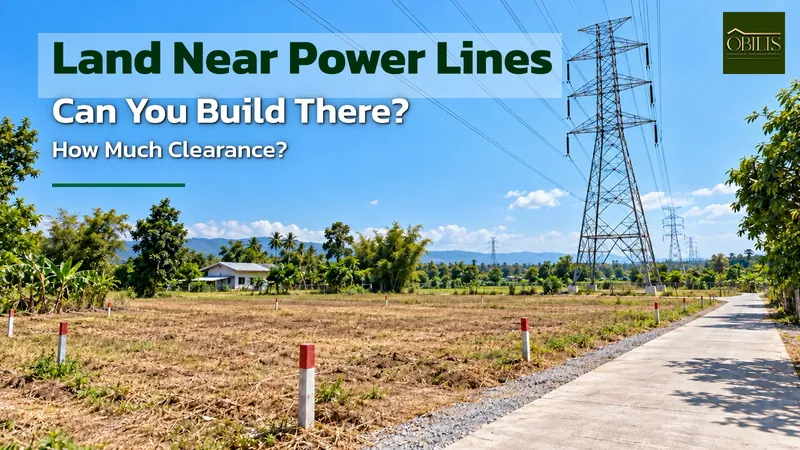
Land near high-voltage power lines is something many house buyers overlook when they walk a plot, because they are focused on the price and the location. A transmission line crossing a plot directly limits where a house can be built, and in some spots building is not possible at all. This is common across Isaan, where high-voltage transmission lines run through large areas of farmland and vacant land.
Plots for sale in Korat and Roi Et that are priced noticeably lower than the land around them often have a hidden reason, and a high-voltage line crossing the property is one of the most common ones. Land under the line is restricted for construction under the rules of EGAT (the Electricity Generating Authority of Thailand), the state utility that operates the transmission grid. Agents do not always disclose this upfront, since it is not information they are legally required to reveal.
These restrictions do not come from zoning rules or the general Building Control Act. They come from EGAT’s own transmission line regulations, which means a buyer needs to check this separately from the usual building-permit process, before deciding where the house will actually sit on the plot.
What Is an EGAT Transmission Line Corridor, and Who Sets the Rules
A transmission line corridor is the strip of land along a high-voltage line that EGAT designates for safety. It covers the area directly under the cables as well as a set distance on either side, not just the spot where each pole or tower stands.
The width of this corridor is set out in EGAT’s own transmission line right-of-way regulations, and it varies by the voltage level of the line running through it. Lines carrying higher voltage are given a wider corridor, because the risk from leakage current or lightning strikes increases with voltage.
The key thing for a landowner to know is that any construction inside this corridor needs written permission from EGAT first, regardless of who owns the land underneath it. Foreigners generally cannot own land in Thailand outright, so this rule matters most for the Thai family members or companies who actually hold the title.
How Far You Must Stay Back From a High-Voltage Line by Voltage Level
The required setback from a high-voltage line changes with the voltage carried on it. For a 69 kV line, the corridor is roughly 9 meters from the centerline on each side. For a 115 kV line, it runs roughly 12 to 25 meters, approximately, depending on the tower type and number of circuits (according to EGAT).
A 230 kV line carries a corridor of roughly 20 to 25 meters, approximately, and a 500 kV line, the highest voltage used on Thailand’s grid, has a corridor as wide as roughly 30 to 40 meters, approximately, on each side of the centerline (according to EGAT).
These figures are measured from the centerline of the towers, not from the boundary of your land. That means you need someone to survey the actual line on site before you can know exactly how much of a given plot falls inside the corridor.
Can You Plant Trees or Build Under a High-Voltage Line
Inside a transmission line corridor, no planting of any kind is allowed within roughly 4 meters of a tower’s base. Elsewhere in the corridor, only mature trees that stay under roughly 3 meters in height are allowed (according to EGAT).
For farmland in Isaan crossed by a high-voltage line, owners can generally keep growing rice or low seasonal crops as usual. What they cannot do is put up a barn, an animal pen, or any permanent structure under the line without permission first. Even raising the ground level with fill inside the corridor may need to be reported to EGAT beforehand.
Getting permission means filing a request directly with EGAT and waiting for approval before any construction starts. Building first and asking later carries a real risk of being ordered to tear the structure back down.
How to Check a Plot Before You Buy If a High-Voltage Line Crosses It
Before committing to a plot you suspect has a transmission line crossing it, check with the local electricity authority office to confirm whether it falls inside an EGAT corridor, and exactly how much of the plot that corridor covers. Ask for written confirmation, not just a verbal answer, so you have something to refer back to later.
Lay the corridor boundary over the land plan and the spot where you plan to place the house, to see whether the remaining area outside the corridor is enough for the house and any future extension. On some plots, the corridor eats up more than half of the usable land.
If a plot really is constrained by a high-voltage line, use that as leverage on the price, and confirm the details directly with the electricity authority office in Korat, Roi Et, Khao Yai, or Pak Chong before putting down a deposit.
Before You Decide on Land Crossed by a High-Voltage Line
Land crossed by a high-voltage transmission line is not automatically off the table, but you need to know the constraints before you buy, so the house layout can be planned outside the corridor from the start instead of running into problems after the design is already done.
The OBILIS team checks the position of any high-voltage corridor against the land plan from the first meeting a client brings in a plot, so the house can be placed outside the restricted zone from day one instead of needing a redesign later.
If you want a figure for the house you actually have in mind, try the budget planner first, or contact us for an estimate based on your real plan and land.
Whoever you build with, if a plot has a high-voltage line crossing it, get EGAT’s written confirmation on file before signing the land purchase agreement or the construction contract.
Related reading: Building Permit in Thailand: SAO Documents and Timeline
Frequently Asked Questions
What is the difference between a high-voltage line and a low-voltage line?
A high-voltage transmission line carries tens of thousands to hundreds of thousands of volts from power plants to substations, with a corridor and setback distances set by EGAT. The low-voltage poles along village roads carry electricity directly into homes, have a much narrower clearance, and fall under PEA (the Provincial Electricity Authority) rather than EGAT.
If a high-voltage line only crosses part of a plot, can you still build a house?
Yes, as long as the area outside the corridor is large enough for the house you want to build. You simply need to position the house entirely outside the restricted zone and apply for a normal building permit for that portion of the land.
Who do you need permission from to build a fence near a high-voltage line?
If the fence line falls inside the transmission corridor, you need to notify EGAT and get permission before building. A tall fence, or one made from conductive material, can count as a structure that requires approval under the corridor regulations.
Key facts at a glance
| Setback for a 69 kV line | approximately 9 meters from the centerline on each side |
|---|---|
| Setback for a 115 kV line | approximately 12 to 25 meters |
| Setback for a 230 kV line | approximately 20 to 25 meters |
| Setback for a 500 kV line | approximately 30 to 40 meters |
| No-planting zone from tower base | approximately 4 meters |
| Max tree height elsewhere in corridor | approximately 3 meters |
Frequently asked questions
Can foreigners buy land crossed by a high-voltage line in Thailand?
Foreigners generally cannot own land in Thailand directly, so this typically applies to a Thai spouse, family member, or Thai company holding the title, who still must follow the same EGAT setback rules.
Does EGAT or PEA regulate high-voltage transmission lines?
EGAT (the Electricity Generating Authority of Thailand) regulates high-voltage transmission lines and their corridors, while PEA (the Provincial Electricity Authority) manages the lower-voltage lines that supply electricity directly to homes.
What happens if you build inside the corridor without permission?
Construction inside an EGAT corridor without written approval can be ordered torn down later, so it is safer to apply and wait for approval before starting any work.
How do you find out if a plot is inside a transmission corridor?
Contact the local electricity authority office, ask them to confirm in writing whether the plot falls inside a corridor, and request the exact width that applies to that line's voltage level.