
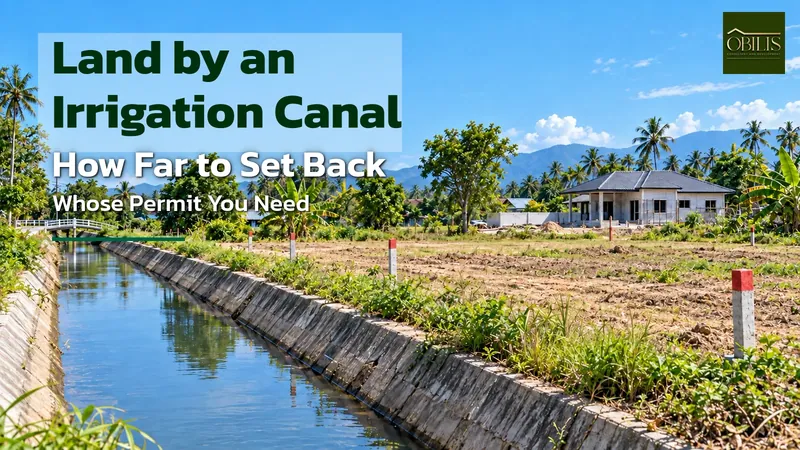
Land Next to an Irrigation Canal in Thailand: How Far Must a House Be Set Back, and Who Approves It?
A house must be set back roughly 3 meters, approximately, from the edge of an irrigation canal (according to RID). If the existing reserve strip is less than 3 meters from the embankment crest, the landowner must cede extra land to complete that distance. Building or using land near a canal requires separate approval from the local irrigation project office, in addition to the normal building permit from the municipality.
- A house must be set back roughly 3 meters, approximately, from an irrigation canal's edge.
- RID requires a reserve strip of at least 3.00 meters from the embankment crest.
- Construction near a canal needs separate approval from the local irrigation project office.
- A joint land survey with an RID officer is required before approval.
Land Next to an Irrigation Canal: What Isaan Landowners Need to Know
Land next to an irrigation canal is common across farmland in Isaan, in both Korat and Roi Et, because it guarantees water year-round and often costs less than land farther from a water source. But this kind of land carries extra construction restrictions that plots facing an ordinary road do not, and many buyers never find out about them beforehand.
Many landowners do not realize that land along an irrigation canal falls under the Royal Irrigation Department (RID) in addition to the normal Building Control Act. Some end up laying out a house close to the canal only to discover later that the whole design has to be redone, losing both time and the design fee already paid.
A common misunderstanding is thinking that as long as the land has a proper title deed (chanote), you can build as close to the canal as you like. In reality, RID has the authority to set its own canal reserve strip on top of the title deed boundary, and that reserve strip is a separate matter from land ownership itself. Foreigners generally cannot own land in Thailand directly, so the title is usually held by a Thai spouse, family member, or Thai company, who still has to follow the same RID reserve strip rules.
What Is the Canal Reserve Strip, and How Is It Different From the Title Deed Boundary
The canal reserve strip is a strip of land that RID sets aside along an irrigation canal for maintenance and water management. It is a separate line from the title deed boundary, even when the land is properly registered.
Under RID’s criteria, if the existing reserve strip is less than 3.00 meters from the crest of the embankment, anyone applying for permission to use the land nearby must cede land to RID to make up a full 3.00-meter reserve strip along the entire boundary facing the canal (according to RID).
Ceding this strip of land is a condition RID applies when reviewing an application to use or build near a canal. It is not something a landowner can simply skip.
How Far a House Must Be Set Back From an Irrigation Canal
Clause 42 of Ministerial Regulation No. 55 (B.E. 2543), issued under the Building Control Act, requires a building near a public watercourse less than 10 meters wide, such as a ditch, canal or drainage channel, to be set back at least 3 meters from the water boundary, measured inward from the canal edge (according to Clause 42 of Ministerial Regulation No. 55). This applies inside building-control zones and is separate from the RID canal-bank strip, which must be left clear on top of it. This leaves room for canal maintenance and helps prevent problems from soil subsidence under a house built too close to the bank.
This 3-meter figure is a baseline used alongside local requirements, and the actual distance can vary by canal type. A main irrigation canal and a small lateral ditch may not carry the same criteria, so it is worth confirming directly with the local irrigation project office.
This RID setback is separate from, and in addition to, any local zoning or municipal setback rules that generally apply to land next to a waterway, so both need to be checked independently.
Which Agency Handles Permission to Use Land in an Irrigation Zone
Applying to use or build near an irrigation canal means filing with the provincial irrigation project office or the RID unit responsible for that particular canal, not just with the local municipality or subdistrict administration.
The process typically requires a joint survey between a Land Department officer and an RID officer to confirm the true position of the reserve strip against the title deed boundary before RID will approve anything (according to RID). Some landowners obtain a local building permit and assume every step is done, only to find the RID approval for the canal reserve is still missing.
Processing time varies with how complex the case is. Landowners should not expect the same timeline as an ordinary building permit, since the joint review with RID is an extra step that takes its own time.
How to Check a Plot Before Buying Land Next to an Irrigation Canal
Before committing to a plot bordered by an irrigation canal, ask the local irrigation project office and the local administration whether the land falls inside a reserve strip that must be kept clear, and how wide that strip is from the embankment crest or canal edge. Ask for the figure in writing rather than relying on a verbal answer.
Measure the actual usable area left after subtracting the reserve strip and setback, to see whether it is still enough for the house you have in mind. Some plots that look wide at first glance turn out to have much less usable area once the reserve strip is subtracted, especially long narrow plots running parallel to the canal.
If the checks confirm real constraints, use that as leverage on price, and keep written confirmation from RID before putting down a deposit on land in Korat, Roi Et, or other farmland areas across Isaan.
Before You Decide on Land Next to an Irrigation Canal
Land next to an irrigation canal is not something to avoid outright, since the water access is a real advantage, but the house layout needs to be planned outside the reserve strip and setback from the very start to avoid a redesign later.
The OBILIS team checks the position of the canal reserve strip against the land plan from the first meeting a client brings in a plot, so the house can be placed on genuinely usable land from the beginning of the design.
If you want a figure for the house you actually have in mind, try the budget planner first, or contact us for an estimate based on your real plan and land.
Whoever you build with, if the land borders an irrigation canal, get RID’s written confirmation of the reserve strip on file before signing the land purchase agreement or the construction contract.
Related reading: Flood-Prone Land: How High to Raise Your Floor in Thailand | Land Use Zoning Colors in Thailand: Which Colors Let You Build a House in Isan
Frequently Asked Questions
Is the irrigation canal reserve strip the same as public land?
No. The canal reserve strip is land RID sets aside specifically to maintain the canal, while public land is land the general public can use under Thailand’s land law. The two need to be checked separately before buying a plot.
If land is next to an irrigation canal but no permission was ever applied for, can you still build a house?
If the house is positioned entirely outside the reserve strip and required setback, you can apply for a normal building permit through the municipality or subdistrict administration, just like any other plot. If the house falls inside the reserve strip or too close to the canal, RID’s separate permission is required first.
Where is the roughly 3-meter setback from an irrigation canal measured from?
It is measured from the actual edge of the canal or the crest of the embankment inward, not from the title deed boundary. It is worth having an irrigation officer point out the true line on site, since the canal’s actual edge does not always match the boundary shown on paper.
Key facts at a glance
| Setback from irrigation canal edge | at least 3 meters, per Clause 42 of Ministerial Regulation No. 55 |
|---|---|
| Minimum reserve strip from embankment crest | 3.00 meters |
| Agency overseeing the reserve strip | Royal Irrigation Department (RID) |
| Step required before approval | joint survey by a Land Department officer and an RID officer |
| Agency that receives the land-use application | provincial irrigation project office |
| Relation to Building Control Act setback | RID's setback applies in addition to it |
Frequently asked questions
What is the irrigation canal reserve strip?
It is a strip of land RID sets aside along a canal for maintenance, separate from the landowner's title deed boundary.
Who approves construction near an irrigation canal?
The provincial irrigation project office or the RID unit responsible for that canal, separate from the building permit issued by the municipality or subdistrict administration.
Where is the roughly 3-meter canal setback measured from?
From the actual edge of the canal or the embankment crest on site, not from the title deed boundary, so an RID officer should point out the real line.
Can you still build a house on land next to an irrigation canal?
Yes, as long as the house is positioned outside the reserve strip and the required setback set by RID.