
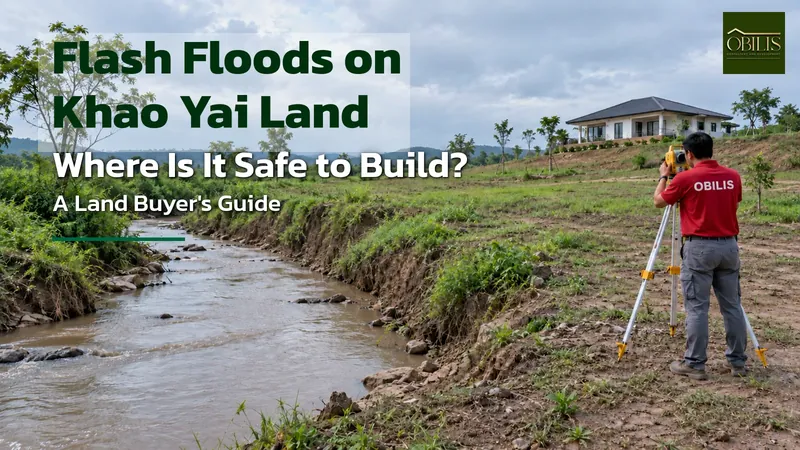
Flash Floods on Khao Yai Land: Where Is It Safe to Build?
Flash floods on Khao Yai land happen because the terrain alternates between hills and elevated plains, making rainwater rush downhill faster than on flat ground. Before siting a house, survey the plot's natural drainage paths and low points, then choose a position higher than the low point that doesn't block the existing water path. Add a drainage trench on the mountain-facing side to catch runoff before it reaches the original drainage path.
- Khao Yai's hilly terrain makes rainwater rush downhill faster than on flat land.
- Survey the plot's natural drainage paths and low points before siting a house.
- Position the house higher than the plot's low point, without blocking the existing water path.
- Add a drainage trench on the mountain-facing side before the slab is poured.
Flash Floods on Khao Yai Land: How Real Is the Risk
Flash floods on Khao Yai land are a real phenomenon, not a rare exception, because the terrain alternates between hills and elevated plains. When heavy rain falls for several hours straight, water from higher ground rushes down far faster than it would across flat terrain.
Risk isn’t the same for every plot. It depends on where a plot sits relative to the mountains and the natural drainage paths around it. Land at the end of a channel or valley sees far more water than land sitting on a ridge or a wide flat area.
Anyone buying Khao Yai land for a vacation house needs to check for flash flood risk at the land-selection stage, not after the house design is finished, because moving a house’s position after the design is done is much harder than picking the right spot from the start.
Flash Floods on Khao Yai Land: Reading Natural Drainage Before You Site a House
Natural drainage paths on Khao Yai land usually aren’t a visible canal or stream running year-round. Many are dry channels that only carry water during heavy rain, which is exactly why buyers who visit during the dry season often never notice them.
The most effective way to read these paths is to walk the whole plot and look at elevation changes, watching for a long continuous low channel, or a strip where vegetation grows noticeably differently from the surrounding area, since channels that carry water often enough support water-tolerant plants in a visible line.
Pair that walk-through with a topographic map or aerial photo of the plot, since an aerial view shows a continuous drainage line running down from the mountain far more clearly than a single ground-level vantage point ever could.
The Low Point of the Plot: Signs of Where Flash Floods Will Run
The low point of a plot is where water from every direction on that plot converges before draining out. This spot usually stays damp longer than the rest of the land, even after several dry days.
Clear signs of a low point include soil that’s noticeably more compacted and damp than elsewhere, or a visible line of sand sediment and leaf debris, both evidence that water has repeatedly flowed through that exact spot.
If a plot has more than one low point, survey all of them and keep the house design set back from every low point as far as practical, not just the most obvious one.
Choosing a House Position That Stays Clear of Flash Flood Paths
A safer house position sits clearly above the plot’s low point and doesn’t block the natural path water takes from the mountain down to the lower flat ground. If the house itself blocks that path, it becomes an obstruction that raises the flood level higher than it would otherwise be.
On sloped or multi-level land, it’s better to site the house on a stable shoulder or ridge and leave the low point as a natural drainage channel, rather than filling the low point flat to build there, since blocking a natural channel usually just pushes the flooding onto a neighboring plot instead.
If the usable area for a house is limited, it may be worth adjusting the house’s size or orientation to avoid the water path, rather than forcing the house onto the most scenic but riskiest spot.
Building Drainage Around the House to Handle Flash Floods on Khao Yai Land
Good drainage around the house needs to capture water from the plot’s natural drainage path and route it back to the land’s original outlet point, instead of letting it pool around the house or seep under the floor or foundation.
On sloped Khao Yai land, a drainage trench should ring the side of the house that faces the mountain, catching water before it reaches the house and directing it back to the original drainage path downhill. This trench needs to go in while the ground is being graded, before the slab is poured or the structure goes up.
If a retaining wall already exists or is planned, leave drainage openings through it too. A retaining wall that seals off the water path completely becomes an unintentional dam, and water pressure building up behind it can eventually cause it to fail.
Let a Team That Knows Khao Yai Read the Land Before You Finalize the House Plan
Reading flash flood paths on Khao Yai land takes both terrain knowledge and real on-site experience, since each plot’s hills and channels differ even within the same sub-district.
OBILIS, which has worked in the Khao Yai and Pak Chong area for years, routinely walks a plot before starting the house design, to position both the house and the drainage system to match that specific plot’s natural water paths, rather than applying the same layout to every site.
To get a rough idea of your budget, try the house budget planner, or contact the team to discuss the details.
Before buying land or finalizing a house plan in Khao Yai, have someone experienced walk the actual plot at least once, ideally when drainage channels are still visible, to reduce the risk of unknowingly siting the house across a water path.
Related reading: Check Flood Risk Before Buying Land in Korat: What to Look For and Land Near a Forest Reserve or National Park in Khao Yai: What to Check Before You Buy
Frequently Asked Questions
How often do flash floods happen on Khao Yai land?
Frequency depends on rainfall and each plot’s specific terrain, with no single figure that applies everywhere. Land at the end of a valley or channel sees flash floods more often than land on a ridge or a wide flat area, so survey the drainage path of each specific plot directly.
Does sloped Khao Yai land always need a retaining wall?
Not necessarily. It depends on the slope and where the house sits relative to that plot’s drainage path. Some plots can be handled with the right house position and adequate drainage trenches alone, without an added retaining wall. Have an experienced surveyor assess the actual plot before deciding.
If I’ve already bought Khao Yai land, can I still check for flash flood paths?
Yes. Walk the plot during or right after rain to see exactly where water flows and in which direction, then use that information to position the house and drainage system at the design stage, before construction starts.
Key facts at a glance
| Why risk varies by plot | Khao Yai's hilly terrain alternating with elevated plains speeds up runoff |
|---|---|
| Signs of a low point | Unusually damp compacted soil, sand sediment, leaf debris lines |
| Safer house position | Higher than the plot's low point, clear of the natural water path |
| What to avoid | Filling the plot's low point flat to build on it |
| Recommended drainage system | A trench around the mountain-facing side of the house |
| Retaining wall caution | Must leave drainage openings; don't seal off the water path completely |
Frequently asked questions
How often do flash floods happen on Khao Yai land?
Depends on rainfall and terrain; there's no single figure that applies everywhere.
Does sloped Khao Yai land always need a retaining wall?
Not necessarily; some plots can be handled with the right house position and drainage alone.
If I've already bought Khao Yai land, can I still check for flash flood paths?
Yes, walk the plot during or after rain to see where water actually flows.
Can I build on the plot's low point if I fill it level?
Not recommended; filling a low point usually just pushes flooding onto a neighboring plot.