
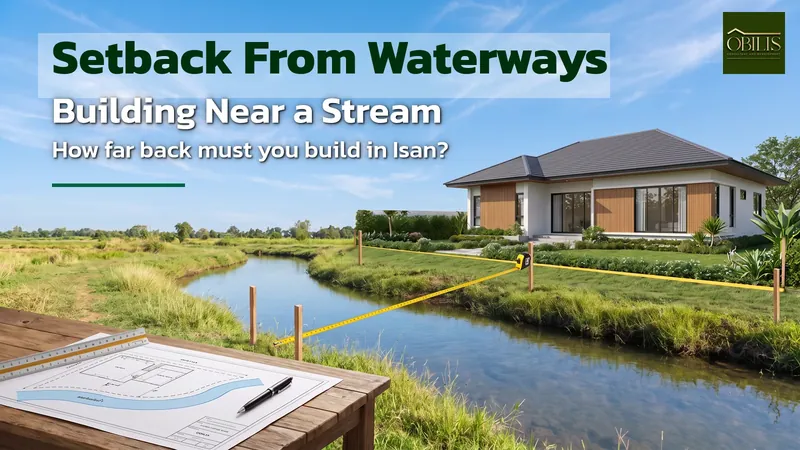
What Is the Building Setback Distance From Water in Isaan?
Under Ministerial Regulation No. 55 (B.E. 2543/2000), the building setback distance from water is approximately 3 meters for a water source narrower than 10 meters, approximately 6 meters for one 10 meters wide or more, and approximately 12 meters for a large water body. This only applies inside a declared building-controlled zone or town plan area. Encroaching on a public waterway also needs Marine Department permission under Section 117.
- Water source narrower than 10 meters needs a setback of approximately 3 meters
- Water source 10 meters wide or more needs a setback of approximately 6 meters
- Large water bodies such as swamps or lakes need a setback of approximately 12 meters
- Structures encroaching on a public waterway need Marine Department permission under Section 117
Building Setback Distance From Water: What It Means Before You Build in Isaan
A family in Roi Et owned a plot of land backing onto a stream (called a “lam huay” in Thai) and wanted to build their house facing the water for the view and cooler air. When they submitted their construction permit application, the local office told them the house was positioned too close to the water and the layout had to be redrawn. This kind of situation is common on waterside land in Isaan, because many landowners do not realize Thai law sets a building setback distance from public waterways.
The setback is the minimum distance a building must be kept back from the boundary of a public water source before construction can start. The rule exists so buildings do not obstruct water flow and so there is room left for maintaining the waterway. Streams, canals and rivers are all treated as public water sources under this rule.
This matters from the design stage, not just when applying for a permit. If a house design is finished before checking the setback, the whole layout may need to be redrawn later, costing time and money. In some cases, a structure built without checking the rule has later been ordered to be moved or partly demolished.
What Ministerial Regulation No. 55 Requires
The main law covering setback distance from water is Clause 42 of Ministerial Regulation No. 55 (B.E. 2543 / 2000), issued under the Building Control Act B.E. 2522 (1979). That clause sets tiered setback distances from the boundary of a public water source, based on the width of that water source. (Source: Department of Public Works and Town & Country Planning; Bangkok Metropolitan Administration’s Public Works Department. Accessed 25 September 2026.)
For a public water source, canal or stream narrower than 10 meters, a building must be set back approximately at least 3 meters from the water boundary. For a water source 10 meters wide or more, such as a river or large canal, the setback is approximately at least 6 meters. For a large public water body, such as a swamp, lake or sea, the setback is approximately at least 12 meters. (Source: Ministerial Regulation No. 55, B.E. 2543.)
There are exceptions for certain structures, such as bridges, dams, fences, drainage pipes, piers, signs, boat shelters and parking areas, which are not held to the same setback as a main building. A residential house or building, however, still needs to follow the setback distance the regulation sets out.
Rural Land Without a Town Plan: Does the Setback Still Apply?
An important caveat: Ministerial Regulation No. 55 only applies in areas officially declared a building-controlled zone, or where an enforceable comprehensive town plan (known locally as a “phang mueang ruam”) is in effect. The 3, 6 and 12-meter figures are therefore not an automatic rule everywhere in Isaan.
Many rural plots in Isaan, especially outside the town centers of Korat and Roi Et, have not been declared building-controlled zones, and some areas still have no enforceable community town plan. In these cases, the setback distance from water depends approximately on the applicable provincial town plan, or is left to the discretion of the local SAO (Or Bor Tor, sub-district administrative organization) or municipality.
Before laying out a house near a stream or river on rural land, always check first with the local SAO or municipality, to confirm whether the land falls inside a building-controlled zone or town plan area, and whether any local setback requirement applies. Checking in advance reduces the risk of a house design running into a setback problem later.
The Marine Department and Encroachment on Waterways
Beyond Ministerial Regulation No. 55, there is a second law to know: Section 117 of the Navigation in Thai Waters Act B.E. 2456 (1913), as amended by Act No. 14 B.E. 2535 (1992). This law prohibits building any structure that encroaches on a public waterway without permission from the Marine Department (Krom Chao Tha). (Source: Marine Department. Accessed 25 September 2026.)
The key point is that this law applies regardless of whether the area is inside a building-controlled zone or not. There have been cases where a landowner built a fence too close to a public canal without realizing Marine Department permission was needed, and was later ordered to move the fence back.
If any part of a structure encroaches into a public waterway, or sits where the Marine Department considers it an encroachment, the owner must file application form Tor. 28 with the Marine Department or the local marine office, along with construction drawings certified by an engineer. The review takes roughly several months, depending on how complete the paperwork is and on the site itself, so confirm the expected timeline with the local marine office before planning the build.
Real Situations From Korat, Roi Et, Khao Yai and Pak Chong
In the Roi Et case mentioned earlier, once the reviewing officer found the house was closer to the stream than the required distance, the layout had to be moved further back onto the land. That meant giving up some of the water view, but it let the permit go through without further problems.
Khao Yai and Pak Chong are popular areas for buying land along a stream or lam huay to build a weekend home. Land in these areas is often subject to stricter town planning control than typical rural land elsewhere, so it pays to check the setback distance and town plan requirements before buying the land, not after grading the site or finalizing the house layout.
In Korat areas where a river or major canal runs through, the setback is often at the 6-meter tier or higher, depending on the water source’s width. If the land borders a waterway under Marine Department jurisdiction, the owner may need permission from both the local authority and the Marine Department before construction starts.
How to Prepare Before Building Near a Stream or River
Before laying out a house near water, start by confirming the exact land boundary, specifically which line marks the true boundary of the public water source, then measure the setback from that line. Using a licensed land surveyor to confirm the boundary is far more reliable than estimating it by eye.
Next, check with every relevant office: the provincial Department of Public Works and Town & Country Planning office, the local SAO or municipality, and, if the land borders a public waterway under Marine Department jurisdiction, the local marine office as well, from the start. This keeps the house design from needing changes later.
One more practical note for foreign buyers: foreigners generally cannot own land in Thailand outright, so waterside land is usually held through a Thai spouse, a Thai company structure, or a long-term lease, and that ownership structure should be settled before the setback and permit questions are worked out. The OBILIS team, building homes in Korat, Roi Et, Khao Yai and Pak Chong, checks the setback distance and town plan requirements for each plot at the design stage, so the finished house does not run into a setback problem later.
If you want a figure for the house you actually have in mind, try the budget planner first, or contact us for an estimate based on your real plan and land.
Related reading: Flood-Prone Land: How High to Raise Your Floor in Thailand | Land Use Zoning Colors in Thailand: Which Colors Let You Build a House in Isan
Frequently Asked Questions
What is the exact building setback distance from water in Isaan?
In areas with an enforceable building-controlled zone or town plan, the setback is approximately 3 meters for a water source narrower than 10 meters, approximately 6 meters for one 10 meters wide or more, and approximately 12 meters for a large water body (Source: Ministerial Regulation No. 55, B.E. 2543/2000). In areas without a building-controlled zone or town plan, these figures may not apply directly, so check with the local SAO or municipality.
If my land is outside a town plan area, do I still need a setback from water?
Ministerial Regulation No. 55 does not apply directly if the area has not been declared a building-controlled zone or does not have an enforceable town plan. Still, always check with the local SAO or municipality first, since some areas add their own local requirements, and if the water is a public waterway, Marine Department permission under Section 117 may still be required.
Do I need permission to build a fence near a public stream?
If a fence or structure encroaches into a public waterway, permission from the Marine Department is required under Section 117 of the Navigation in Thai Waters Act, filed using form Tor. 28 with engineer-certified drawings, a review that takes roughly several months. If the fence stays entirely within the private land boundary and does not encroach on the waterway, this permission is usually not required, but confirm the boundary before building.
Key facts at a glance
| Main law | Clause 42, Ministerial Regulation No. 55 (B.E. 2543/2000), issued under the Building Control Act B.E. 2522 |
|---|---|
| Setback for water source under 10m wide | approximately 3 meters |
| Setback for water source 10m wide or more | approximately 6 meters |
| Setback for large water bodies (swamp, lake, sea) | approximately 12 meters |
| Public waterway law | Section 117, Navigation in Thai Waters Act B.E. 2456, requires Marine Department permission |
| Marine Department encroachment permit timeline | roughly several months; filed on form Tor. 28 |
Frequently asked questions
Does the building setback distance from water apply everywhere in Isaan?
No. Ministerial Regulation No. 55 only applies inside a declared building-controlled zone or an area with an enforceable town plan; rural land without one falls under the local SAO or municipality's discretion instead.
If my land is outside a town plan area, do I still need a setback from water?
The regulation does not apply directly, but check with the local SAO or municipality, and note that Marine Department permission under Section 117 may still be required for a public waterway.
Do I need permission to build a fence near a public stream?
Only if the fence encroaches on the public waterway; then Marine Department permission is required under Section 117, filed with form Tor. 28.
How long does Marine Department encroachment approval take?
Roughly several months, after filing form Tor. 28 with engineer-certified construction drawings. Confirm the timeline with the local marine office.