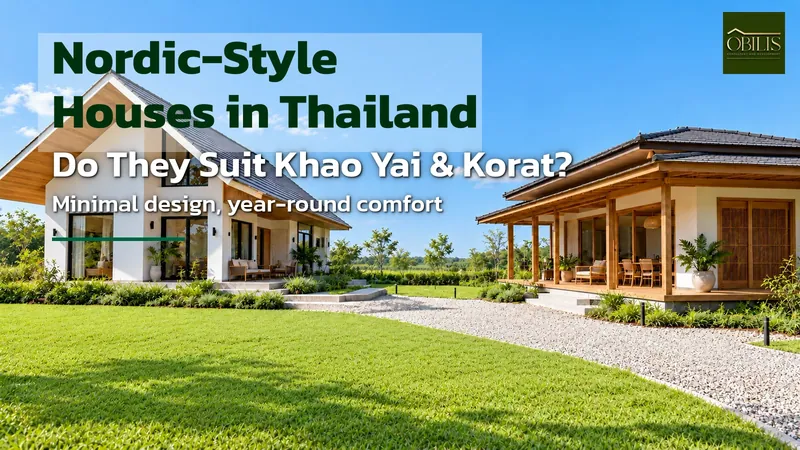
Nordic-Style houses: do they suit the climate in Khao Yai and Korat, and what needs adjusting?
A Nordic-style house can work well in Khao Yai and Korat, but the roof pitch should be sized for rain drainage rather than snow shedding, eaves need to be wider to keep rain off walls and windows, exterior paint should resist mold and reflect heat, and wood exposed to sun and rain should be kiln-dried or engineered rather than solid untreated wood. With these adjustments, the house stays comfortable through Thailand's hot, humid seasons.
- Adjust the roof pitch for rain drainage instead of snow shedding
- Widen the eaves to keep rain off walls and windows
- Choose mold-resistant, heat-reflective paint for exterior walls
- Use kiln-dried or engineered wood in sun- and rain-exposed spots
What Is a Nordic-Style House, and How Is It Different from Muji Style?
A Nordic-style house draws inspiration from the Scandinavian countries: clean lines, a steep gable roof built to shed snow, white or light-colored walls, and wood as the main material both inside and out. Muji style takes this further, stripping away even more detail to focus on flat surfaces and open space.
Both styles share the same core idea: simplicity, little to no ornamentation, natural color tones, and interiors left as open as the structure allows. This is quite different from traditional Thai houses, which usually have many openings and carved wooden lattice screens.
Homeowners in Korat and Khao Yai who like this look often say it feels calm and needs little extra decoration. But it helps to understand first that most reference photos were designed for cold climates, not for the hot, humid weather of Isan.
Why Nordic-Style Houses Are Popular in Thailand Right Now
The Nordic house trend has grown alongside the rising popularity of Scandinavian furniture and home decor, which is now much easier to find in Thailand. People who already like this minimal look naturally want a house that matches the furnishings they already own.
Another reason is that this style photographs well. A house doesn’t need elaborate finishing details to look good in pictures, which is why many young homeowners building their first house often put this style at the top of the list when they first talk to a design team.
But that simplicity comes at a cost: the building systems have to be planned carefully from the very start. This style doesn’t hide wiring and air-conditioning pipework behind ceiling trim or decorative elements the way other styles can, so sloppy work shows far more clearly than it would on a style full of pattern to disguise it.
What Needs to Change When Building a Nordic-Style House in a Hot Climate
The steep gable roof of Nordic design was built to shed snow quickly, but there’s no snow in Korat or Khao Yai. What matters instead is a pitch that drains rainwater well without trapping excessive heat under the roof.
Large windows that let in abundant light work well in a cold Nordic city, but used as-is facing Isan’s strong sun, rooms get hot and the air conditioner has to work much harder. Window sizes need to be adjusted, or external sunshades added instead.
The white walls that define this style can develop black mold stains far faster than in a cold climate if the paint and materials aren’t chosen for humidity resistance, because relative humidity in Isan is much higher, especially during the late-rainy, early-cool season.
Materials and Colors That Suit the Khao Yai and Korat Climate
Wood can still be the main material for this style, but for spots directly exposed to sun and rain, choose kiln-dried real wood or engineered wood treated with a moisture-resistant coating. Save solid, untreated wood for areas sheltered under eaves or used indoors.
White or soft pastel colors still work, but exterior walls should use paint formulated to resist mold and reflect heat, especially on the afternoon-sun-facing side of houses in Khao Yai, where the surrounding forest keeps the air humid.
The wood flooring that’s a hallmark of Nordic living rooms can be replaced with wood-look tile near the entry door or in areas that get wet often, giving the same look while reducing moisture problems, if solid wood isn’t practical there.
Common Mistakes When Building This Style Upcountry
The first mistake is copying a design straight from abroad without adjusting the roof’s orientation and pitch, resulting in a house that looks just like the photo but runs hotter and costs more to cool than it should.
The second mistake is cutting the eaves back almost entirely to get the clean lines seen in photos, which lets rain hit the walls and windows directly; leak and mold stains follow much sooner than on a house with normal-sized eaves.
The third mistake is choosing flooring or paint that matches the look in reference photos but doesn’t suit the real climate — for example, solid wood that hasn’t been properly kiln-dried in a spot exposed to sun and rain, which will swell or crack sooner than it should.
How to Work with a Design Team to Get a Nordic House That’s Actually Comfortable
Start by telling the design team plainly what you like about Nordic or Muji style — the openness, the white tones, the wood — and let them translate that feeling into elements suited to the real climate, rather than copying a reference design wholesale.
Ask to see the eave structure and moisture-protection details before deciding, because the simplicity visible from the front of the house often hides building systems and waterproofing work that need to be more careful than on other styles.
OBILIS adapts Nordic and Muji-style house designs to suit the climate of Korat and Khao Yai while keeping the clean look homeowners love, adjusting the eaves, orientation, and materials so the house stays comfortable to live in all year round.
To get a rough idea of your budget, try the house budget planner, or contact the team to discuss the details.
Related reading: Designing a Vacation Home in Khao Yai: Layout Tips for Easy Weekends
Related reading: Resort-Style House Design for Mountain-View Land Near Khao Yai and Pak Chong
Related reading: Designing a House on Narrow-Frontage Land in Thailand for Light and Airflow
Frequently Asked Questions
Which suits a hot climate better, Nordic style or Muji style?
Both styles can be adapted for hot weather about equally well, since the key factor is adding eaves and ventilation openings, not which style is chosen. The main difference between them is really the level of minimalism in the interior finishing, not the exterior structure.
Is a Nordic-style house harder to build than a standard house?
It isn’t harder structurally, but it does demand more precise workmanship, because the flat wall surfaces have no pattern to hide imperfections. Builders who work carefully will get results that match the design far more closely in this style.
I like Nordic style but my land is small — can the design be adjusted?
Yes. This style’s simplicity actually suits a small plot well, since it doesn’t need extra space reserved for elaborate decorative details. What you should discuss with your design team is sizing the eaves and openings to fit the space you actually have around the house.
Key facts at a glance
| Roof shape | Steep gable, pitch adjusted for rain drainage rather than snow |
|---|---|
| Main material | Kiln-dried or engineered wood for sun- and rain-exposed areas |
| Wall color | White or pastel paint with mold resistance and heat reflection |
| Living room floor | Wood-look tile instead of solid wood near entries or wet areas |
| Common mistake | Cutting eaves too short lets rain hit walls and windows directly |
| Design partner | OBILIS adjusts eaves, orientation, and materials for year-round comfort |
Frequently asked questions
Which suits a hot climate better, Nordic style or Muji style?
Both adapt to hot weather about equally well, since the key is adding eaves and ventilation openings rather than which style is chosen.
Is a Nordic-style house harder to build than a standard house?
Not structurally harder, but it demands more precise workmanship, since flat wall surfaces have no pattern to hide imperfections.
I like Nordic style but my land is small — can the design be adjusted?
Yes, this style's simplicity actually suits small plots well; just adjust the eave and window proportions to fit the available space.
What happens to white Nordic-style walls in Isan's humid climate?
Without mold-resistant, moisture-tolerant paint and materials, white walls develop black mold stains much faster than in a cold climate, especially late in the rainy season.