What Is a Modern Tropical House and Why Does It Suit Korat and Khao Yai's Climate?
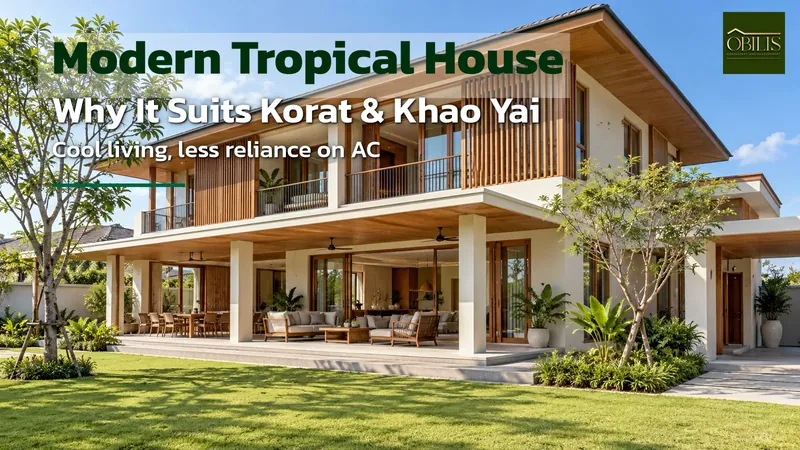
A modern tropical house updates traditional tropical architecture with deep overhanging eaves, open ventilation gaps, and moisture-resistant materials. These features block intense sun and driving rain while letting prevailing breezes pass through, so rooms stay naturally cooler. In Korat and Khao Yai, where heavy rain, strong sun, and high humidity alternate through the year, this approach reduces reliance on air conditioning and prevents damp, stagnant corners around the house.
- Deep overhanging eaves block both intense sun and driving rain.
- Ventilation openings and operable windows let prevailing breezes flow through the house.
- Materials like exposed concrete and tinted glass reduce the air conditioner's workload.
- Mature trees around the house cut heat buildup on walls more than air conditioning alone.
What Is a Modern Tropical House?
A modern tropical house takes traditional tropical architecture and updates it for contemporary living: deep overhanging eaves, open airflow gaps, and materials built to withstand humidity. It isn’t simply a European-style house painted white with a few timber slats tacked on.
The concept traces back to traditional Thai and Malay houses raised on stilts, with openings on every side and steep roofs that vent heat. Later architects kept the same principles but simplified the lines, stripping away ornate fretwork and keeping only what actually works.
Homeowners in Korat and Khao Yai who come in for design consultations often use “modern tropical” to mean a house that feels open and light, never closed-in, yet still carries quiet elegance in its simple lines — which lines up closely with how architects actually define the style.
Why It Suits Isaan’s Hot, Humid Climate
Lower Isaan around Korat swings between intense sun and heavy rain. A house without deep eaves tends to get rain driven against its walls and direct sun hitting the glass, which overheats rooms and forces the air conditioning to work harder than it should.
A modern tropical house addresses this at the design stage. Deep eaves block both sun and rain, and openings are placed to catch the prevailing local breeze rather than facing a large glass wall west simply because it looks good.
In Khao Yai and Pak Chong, where the air is cooler than in town but humidity stays high from the surrounding forest and mountains, this style also reduces damp, stagnant corners that never see direct sun — because ventilation openings are built in from the start at multiple points.
The Key Elements of This Style
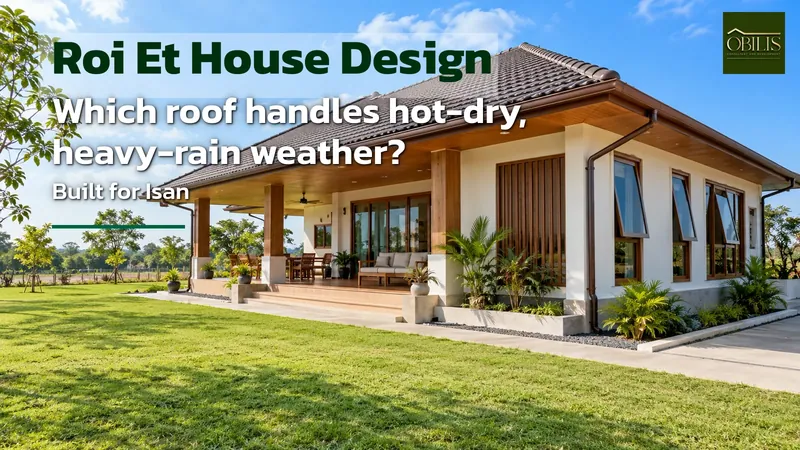
The first giveaway is a hip roof or a low-pitched gable with long, deep eaves. Next come timber louvres or breeze blocks that cut glare without blocking airflow, plus large windows that genuinely open rather than fixed panes of glass top to bottom.
Transitional spaces between indoors and outdoors — a porch, a veranda, or a covered hall under the eaves — are just as essential, since they let people sit outside and catch the breeze without running the air conditioner all day.
Trees and water features around the house are part of the design itself, not an afterthought for the landscaping crew. Shade from mature trees cuts the heat building up on walls far more than relying on air conditioning alone ever could.
Materials Commonly Used
Real or wood-grain composite timber lines walls and forms sun-shading louvres, giving a warm feel other materials struggle to match. Exposed or polished concrete goes on surfaces that take direct sun and rain, since it holds up with far less upkeep than real wood.
Roofing is usually a lightweight, heat-reflective material so the structure doesn’t need to be built any heavier than necessary. Walls that face the sun all day typically get an extra layer of insulation above the standard spec.
Glass should be tinted or double-glazed at points that catch the afternoon sun, not clear glass throughout. The extra cost at construction is usually lower than the extra electricity bill paid every month for years afterward.
Things to Watch For When Building in Korat and Khao Yai
Two neighboring plots can face completely different sun and wind directions, especially in Khao Yai, where mountains block the prevailing breeze in certain areas. Copying a modern tropical design from elsewhere without checking orientation first can leave you with a house that looks good but runs hotter than it should.
Long overhanging eaves need extra structural calculation to carry the added load — they aren’t just timber bolted on and left. Builders unfamiliar with this style often shorten the overhang, which quietly cuts the house’s sun and rain protection in half.
Timber louvres and breeze blocks that look sharp on handover day will start rotting or growing mold within the first year or two if the material isn’t moisture-resistant. Ask the contractor up front, in clear terms, which material grade goes into the spots that take the most rain.
How to Choose a Design Team for the Right House
A modern tropical house depends on understanding the local climate more than most other styles do. A design team that has actually built this style in the area will know which directions in Korat or Khao Yai need shielding from afternoon sun, and where to open the house up to the breeze.
Ask the design team to explain the reasoning behind every eave and every opening in the plan, not just that it “looks good.” These elements genuinely cut heat and humidity — they aren’t decoration for its own sake.
OBILIS designs tropical-style houses for homeowners in Korat and Khao Yai, starting by reading each site’s actual sun and wind direction before laying out the plan, so the finished house looks good and stays comfortably cool all year round.
To get a rough idea of your budget, try the house budget planner, or contact the team to discuss the details.
Related reading: Resort-Style House Design for Mountain-View Land Near Khao Yai and Pak Chong
Frequently Asked Questions
How Is a Modern Tropical House Different From a Regular Modern House?
A regular modern house focuses mainly on clean lines and boxy massing, without being designed specifically for a tropical climate. A modern tropical house adds deep eaves, ventilation openings, and moisture-resistant materials as the core of the design itself, not just surface decoration.
Does Building a Modern Tropical House Cost More Than a Standard Box-Shaped House?
The added cost mostly comes from the structural work for long eaves and from materials like timber louvres or breeze blocks, which run somewhat higher than a plain box-shaped house but not dramatically so. It depends more on the material grade chosen than on the style itself.
What Kind of Land Suits a Modern Tropical House Best?
It suits land with enough room for deep eaves and with trees or open space around the house to let the breeze pass through. On a narrow plot hemmed in by neighbors on every side, the proportions of the eaves and openings need to be adjusted to fit the limited space instead.
Key facts at a glance
| Roof shape | Hip roof or low-pitched gable with long overhanging eaves |
|---|---|
| Wall materials | Real or wood-grain composite timber paired with exposed or polished concrete |
| Glass | Tinted or double-glazed glass at points that catch afternoon sun |
| Transitional spaces | Porch, veranda, or covered hall under the eaves |
| Suited locations | Korat, Khao Yai, and Pak Chong |
| Maintenance risk | Timber louvres and breeze blocks can rot or grow mold within one to two years if the material isn't moisture-resistant |
Frequently asked questions
How Is a Modern Tropical House Different From a Regular Modern House?
A regular modern house focuses mainly on clean lines and boxy massing, without being designed specifically for a tropical climate. A modern tropical house adds deep eaves, ventilation openings, and moisture-resistant materials as the core of the design itself, not just surface decoration.
Does Building a Modern Tropical House Cost More Than a Standard Box-Shaped House?
The added cost mostly comes from the structural work for long eaves and from materials like timber louvres or breeze blocks, which run somewhat higher than a plain box-shaped house but not dramatically so. It depends more on the material grade chosen than on the style itself.
What Kind of Land Suits a Modern Tropical House Best?
It suits land with enough room for deep eaves and with trees or open space around the house to let the breeze pass through. On a narrow plot hemmed in by neighbors on every side, the proportions of the eaves and openings need to be adjusted to fit the limited space instead.
Does a Modern Tropical House Always Need Trees Around It?
Not strictly, but mature trees and open space around the house provide shade that cuts heat buildup on the walls and support natural ventilation, which is why designers usually recommend them alongside deep eaves and airflow openings.