Why Your House Needs a Construction-Supervising Engineer in Thailand
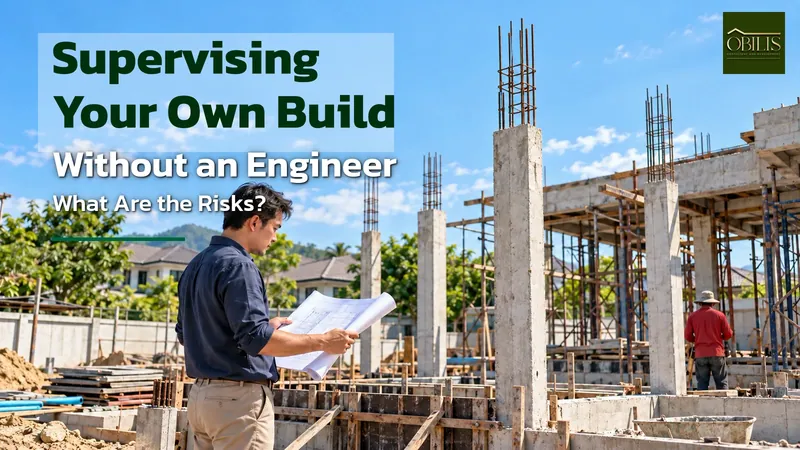
Self-supervising house construction without a licensed construction-supervising engineer carries real legal and technical risk in Thailand. The Building Control Act requires the permit holder to notify the local authority of the supervisor's name, and unchecked foundation or structural work often goes unnoticed until problems appear. Structurally complex houses generally need a licensed controlled-engineering professional, while private homes up to 150 square meters are generally exempt from requiring an architect's signature.
- Thailand's Building Control Act requires notifying the local authority of the supervisor's name.
- Structurally complex houses are more likely to require a licensed controlled-engineering professional.
- Without a knowledgeable supervisor, contractors can quietly downgrade material specs unnoticed.
- Private homes up to 150 square meters are generally exempt from requiring an architect's signature.
Who Is a Construction-Supervising Engineer, and Why Does the Law Care?
A construction-supervising engineer, sometimes simply called the site supervisor, is the person responsible for making sure a build, renovation, or demolition follows the approved drawings. Under Thailand’s Building Control Act B.E. 2522 (1979), whoever holds the building permit must formally notify the local authority of that supervisor’s name along with the start and end dates of the work.
Many people assume this role is just a line on a permit form, but in practice the supervisor is the one who answers for it if the finished building strays from the approved plans or falls short of safety standards. This matters most for structural work, since mistakes there affect how safe and stable the house remains for decades. The responsibility carries far more weight than a signature on an application.
Plenty of homeowners in the provinces choose to supervise their own build from start to finish simply to save money, without realizing how much legal and technical exposure that decision creates. Some only understand the risk once something has already gone wrong and they are left scrambling to find someone who can be held accountable after the fact.
What Size of House Actually Triggers Stricter Engineer Requirements?
An ordinary private home that is not especially large and has no unusual structural features, such as abnormally wide column spans or a height beyond typical residential standards, generally does not fall under the “controlled engineering” work defined by ministerial regulation. Even so, the Building Control Act still requires that a construction supervisor be named for the project.
A house with a more complex structure, on the other hand, is more likely to need a professional who holds an actual controlled-engineering license. Multiple mezzanine levels, unusually wide spans, or a large structural addition all push a project closer to that threshold compared with a standard-shaped home.
Because the exact line depends on the structural details of each individual house, homeowners who are unsure should ask an engineer or the Council of Engineers directly, on a case-by-case basis, rather than guessing from a rough sense of the home’s size. Raising the question with the designer as early as the construction-drawing stage can also give a clear answer well before the build begins.
The Real Risks of Building Without a Qualified Site Supervisor
The most common problem is foundation and structural work that never gets checked along the way, things like rebar spacing that does not match the drawings or concrete that was not mixed to standard. These issues become invisible to the naked eye the moment the concrete is poured, and they usually go unquestioned when there is no supervisor who genuinely understands the plans.
Without a supervisor who understands the BOQ and construction drawings in detail, some contractors quietly downgrade material specifications or change how a task is carried out without telling the homeowner, banking on the fact that nobody is checking in real time. The resulting damage often only becomes obvious months or even years after the family has moved in.
When a dispute with a contractor arises, having no supervisor who kept systematic inspection records puts the homeowner at a serious disadvantage when trying to prove a defect came from poor workmanship rather than how the house was later used. Many construction disputes are lost by homeowners for no reason other than a lack of inspection evidence collected from day one.
Supervisory Duties That Homeowners Often End Up Skipping
A supervisor who is doing the job properly checks every stage of work against the BOQ and construction drawings before approving each payment draw, rather than simply walking through and eyeballing whether things look finished. This is exactly the kind of thorough, document-by-document check that homeowners without a construction background tend to skip or do only partially.
Verifying that materials arriving on site match the brand and grade written into the contract is another duty that has to happen consistently, not just at the first delivery while later draws get waved through. Some contractors swap in cheaper materials partway through the project once they sense that nobody is checking every shipment.
Recording and photographing progress at each stage as evidence is a part of the job that is frequently overlooked, yet it turns out to be the most valuable record if a dispute later needs to be proven. This matters especially for work that later gets covered over by other materials, such as plumbing run inside a wall or rebar buried beneath a slab, since none of that can be inspected again once it is sealed up.
Alternatives for Homeowners Who Don’t Want a Full-Time Construction-Supervising Engineer
Hiring a full-time supervising engineer is not necessarily required for every house. Bringing in an independent inspector periodically, timed to each payment draw, is a lower-cost alternative that still gives the project a structurally trained set of eyes at the points that matter most.
Homeowners who go with a home-building company that already includes a supervisor as part of the service should still ask directly how often that person actually visits the site and what inspection process is in place, rather than assuming the job is done just because a name appears on the permit paperwork.
Whichever route is chosen, the underlying principle stays the same: someone who genuinely understands the drawings and the BOQ needs to be checking the work on the homeowner’s behalf on a regular basis. The contractor should never be allowed to act as both the builder and the sole inspector of their own work.
A Final Word on Site Supervision Before You Commit to Building
At OBILIS, a supervisor visits every project’s site on a clearly defined schedule, checking the actual work against the BOQ and construction drawings at every payment draw before any funds are released. The goal is to spare the homeowner from having to reconstruct proof of a problem after the fact.
If you want a figure for the house you actually have in mind, try the budget planner first, or contact us for an estimate based on your real plan and land.
For homeowners who decide to work with an independent contractor instead of going through a home-building company, the advice remains the same: hire a supervisor or independent inspector regardless of whether the house technically falls under the legal requirement, because the cost of doing so is almost always far smaller than the damage it can prevent.
Investing in proper site supervision from the outset is not an extravagance; it is a core part of managing risk, every bit as important as choosing the house design or picking a contractor. Homeowners who skip this step often end up paying for repairs later that cost many times more than a supervisor’s fee ever would have.
Frequently Asked Questions
Does an Ordinary Single-Storey House Need a Construction-Supervising Engineer?
A typical single-storey house with no unusual structural features may fall outside the technical criteria for controlled engineering work, but the Building Control Act still requires that a supervisor’s name be filed with the local authority. It is worth checking the details with the local office or an engineer before construction actually begins.
Is It an Offense to Supervise Construction Without an Engineering License?
Practicing controlled engineering without a license issued by the Council of Engineers is an offense under the Engineer Act B.E. 2542 (1999), which carries both potential imprisonment and fines. Anyone a homeowner is considering for this role should have their license checked and confirmed before being assigned the job.
Does a Small Residential House Always Need an Architect to Sign Off the Design?
A private residence of no more than 150 square meters is generally exempt from requiring an architect’s signature certifying the design. That said, rules can vary depending on the location and the nature of the building, so it is best to confirm with the local authority before actually submitting a building-permit application.
Key facts at a glance
| Main relevant law | Building Control Act B.E. 2522 (1979) |
|---|---|
| Permit holder's duty | notify local authority of supervisor's name |
| Law for unlicensed practice | Engineer Act B.E. 2542 (1999) |
| Architect sign-off exemption size | up to 150 square meters, generally |
| Main risk | unchecked foundation and structural work |
| Lower-cost alternative | independent inspector at each payment cycle |
Frequently asked questions
Does a simple single-story house need a construction-supervising engineer?
It may not require licensed controlled-engineering work, but the Building Control Act still requires notifying the local authority of a construction supervisor's name.
Is it illegal to supervise construction without an engineering license?
Yes, practicing controlled engineering without a license is an offense under the Engineer Act, carrying both imprisonment and fines, so verify credentials before assigning the role.
Does a small house always need an architect's signature?
Homes up to 150 square meters are generally exempt, but you should confirm with local authorities before applying for a permit.
What duties does a construction supervisor handle that owners often miss?
Checking work against the BOQ every payment cycle, verifying materials on site, and keeping dated photo records of progress.