What must residential electrical wiring standards in Thailand follow to be safe?
Thai residential wiring is referenced against the EIT wiring standard (วสท. 022001-22), issued by the Engineering Institute of Thailand, which covers conductors, branch circuits, and general installation for homes. Cable must carry the TISI mark under มอก. 11-2553, and PEA, the Provincial Electricity Authority, recommends an RCD rated at 30 mA or less on circuits exposed to water, such as bathrooms and outdoor areas, to prevent electric shock.
- Reference the EIT wiring standard from the design stage
- Use only TISI-marked cable under มอก. 11-2553
- Install a 30 mA or lower RCD on water-exposed circuits
- Leave spare slots in the consumer unit for future circuits
Residential Electrical Wiring Standards: Why They Matter From Day One
Electrical wiring standards for a house are not something a homeowner should leave entirely to the electrician’s judgment. A home with undersized wiring, or wiring that skips a safety step, risks short circuits and fire at any time. Across Isaan — Korat, Roi Et, Khao Yai, Pak Chong — many houses get their wiring altered or extended later, and each change adds another point of risk.
Good electrical work starts with a correct design from the planning stage, not with fixes improvised on site. A homeowner who understands the basic standards can ask the contractor sharper questions, and that lowers the chance the work has to be torn out and redone later.
A common problem is that homeowners only see a finished wall, not the wiring and panel hidden behind it. By the time wiring problems surface — frequent power cuts, breakers that trip often, or a burning smell from an outlet — they are harder to fix than if they had been checked from the start.
The EIT Wiring Standard: The Main Reference for Residential Electrical Work
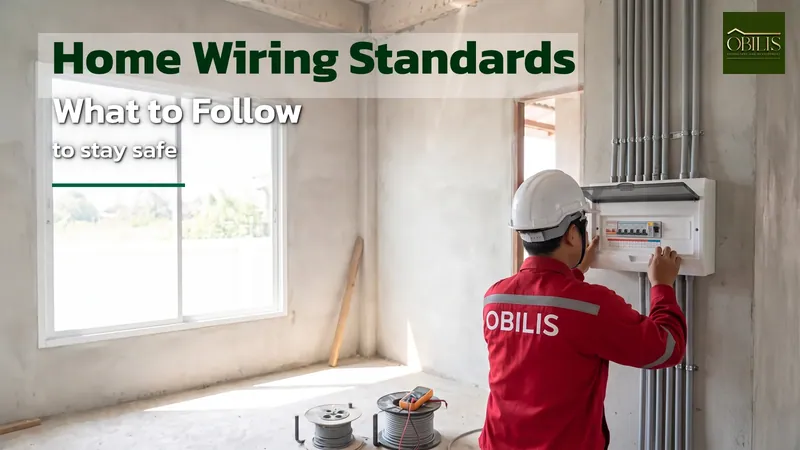
Thailand has a national wiring standard, the Wiring Installation Standard for Thailand B.E. 2564, code วสท. 022001-22, issued by EIT (the Engineering Institute of Thailand) (referencing EIT, eit.or.th). It covers conductors, the main distribution system, branch circuits, and general installation requirements for low-voltage systems in residential buildings.
A contractor familiar with this standard separates circuits by use — one circuit for outlets, another for lighting, another for the air conditioner — instead of running everything through a single circuit to save on wire.
When a house goes through inspection before permanent power is connected, wiring that does not follow a recognized standard is usually flagged for correction first, which costs the contractor time and the homeowner money. Ask from the outset which standard the electrical drawings reference.
Wiring and Fittings Must Carry a TISI Mark
Wiring used in a house must be PVC-insulated cable that meets TISI (the Thai Industrial Standards Institute) standard มอก. 11-2553, for rated voltages up to 450/750 volts (referencing IEC 60227 and the Ministry of Industry notice published in the Royal Gazette). This is a mandatory standard, not an optional one.
On site, unmarked cable without the TISI mark shows up now and then, usually noticeably cheaper than standard cable. Its insulation is thinner and handles heat less well, and over years it can crack and cause a hidden leakage fault.
A homeowner can check this directly on the cable itself — the printing along its length should show the size, voltage rating, and TISI mark. If a contractor will not show you the cable reel before it goes into the wall, treat that as a warning sign.
Residual Current Devices (RCDs): The Point Most Often Skipped
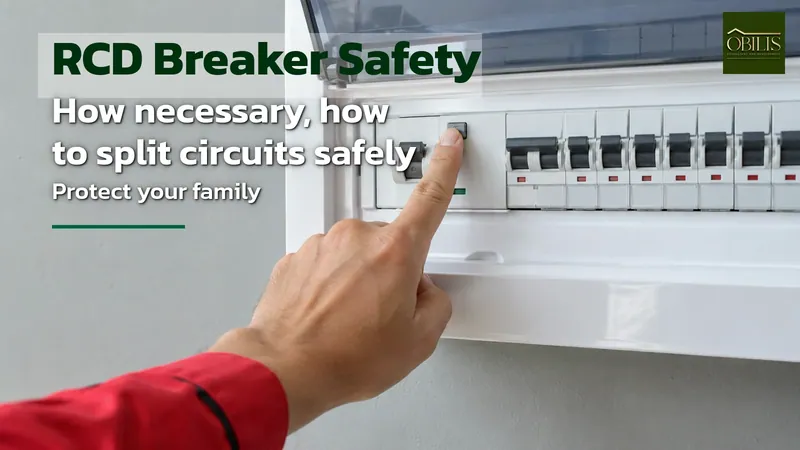
PEA (the Provincial Electricity Authority) recommends that every home install a residual current device (RCD) with a trip current of no more than 30 milliamps to protect against electric shock and current leakage (referencing PEA, standards มอก. 909-2548 and มอก. 2452-2560).
On site, some electricians take a shortcut and skip the RCD to save cost and steps, telling the homeowner that a standard breaker is enough. It is not the same protection — an ordinary breaker trips on overcurrent, but it does not trip on a leakage current running through a person.
At minimum, the bathroom circuit, outdoor circuits, and any point exposed to water should have RCD protection. Ask to see the actual panel and ask directly which circuits the RCD covers.
A Consumer Unit Sized to the Standard
The consumer unit (breaker panel) needs to be sized to the actual number of circuits the house needs, not the smallest box available just to save money during construction.
Many houses in Khao Yai and Pak Chong that were extended later ran into a panel with no room left for another breaker, forcing a full panel replacement, or forcing an oversized breaker into an undersized panel, which is not safe.
A well-planned panel leaves some room for the future — at least two to four spare slots — to cover circuits that may be added later, such as a water heater, a water pump, or an extra air conditioning unit.
Choosing a Contractor Who Follows Wiring Standards Strictly
Choosing a contractor who understands and follows residential wiring standards from the start reduces both safety risks and delays at inspection. It is also worth noting that foreigners generally cannot own land in Thailand outright, so many foreign homeowners build on land held by a Thai spouse or under a long-term lease structure, which makes a documented, standard-compliant electrical design even more important when the house changes hands or gets extended later.
OBILIS, which builds houses across Korat, Roi Et, and Isaan, designs the electrical system with reference to the EIT wiring standard from the design stage onward, so the homeowner can trace every step of the work.
If you want a figure for the house you actually have in mind, try the budget planner first, or contact us for an estimate based on your real plan and land.
Before permanent power is connected, PEA inspects the home’s internal wiring system. Keeping the electrical drawings and material certificates on hand from the start helps this step go through without rework, and in 2026 that habit of keeping documents in order still saves the most time at inspection.
Related reading: Applying for a Permanent Electricity Meter After Your House Is Built: Documents and Timeline | Temporary Electricity and Water for Construction in Thailand
Frequently Asked Questions
What is the main electrical wiring standard used in Thailand?
The main reference is the Wiring Installation Standard for Thailand B.E. 2564 (2021), code วสท. 022001-22, issued by EIT, the Engineering Institute of Thailand (referencing eit.or.th). It covers conductors, branch circuits, and general installation practice for residential buildings.
Does every circuit in a house need an RCD?
PEA recommends an RCD rated at no more than 30 milliamps, at minimum on circuits exposed to water, such as the bathroom and outdoor circuits (referencing PEA, standards มอก. 909-2548 and มอก. 2452-2560). Ask to check the actual panel to confirm it is installed.
Can wiring without a TISI mark be used?
It should not be. PVC-insulated cable used in a house must meet มอก. 11-2553, a mandatory standard (referencing the Royal Gazette and TISI). Unmarked cable has no quality control behind it and risks a leakage fault over time.
Key facts at a glance
| Main standard | วสท. 022001-22, the Wiring Installation Standard for Thailand B.E. 2564, by EIT |
|---|---|
| Cable requirement | TISI มอก. 11-2553 for PVC-insulated cable up to 450/750 volts |
| RCD | PEA recommends an RCD rated at 30 mA or less |
| RCD product standards | มอก. 909-2548 and มอก. 2452-2560 |
| Where RCDs matter most | Bathroom circuits and outdoor circuits |
| Consumer unit | Leave at least 2-4 spare slots for future circuits |
Frequently asked questions
What is the main electrical wiring standard used in Thailand?
The main reference is the Wiring Installation Standard for Thailand B.E. 2564, code วสท. 022001-22, issued by EIT (referencing eit.or.th).
Does every circuit in a house need an RCD?
PEA recommends an RCD rated at no more than 30 mA, at minimum on water-exposed circuits like bathrooms and outdoor areas.
Can wiring without a TISI mark be used?
It should not be. Cable used in a house must meet มอก. 11-2553, a mandatory standard under the Royal Gazette notice.
How much spare space should a consumer unit have?
At least two to four spare slots, to cover circuits that may be added later, such as a water heater or extra air conditioner.