
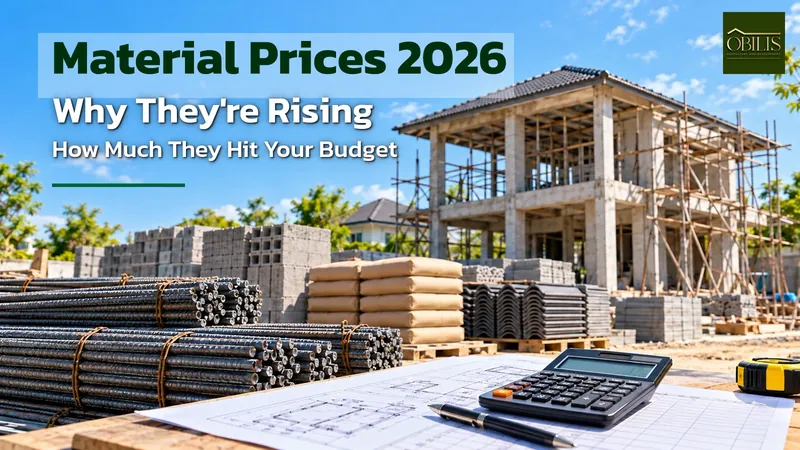
Construction Material Prices in Thailand 2026: Why They Are Rising and How Much They Affect Your House Budget
Construction material prices kept rising through 2026 per TPSO's official index, with the cement category up 5.6% in February and the steel category up 5.4% in May. The main drivers were rising energy costs and the ongoing Middle East conflict affecting production and transport. The impact on each house's budget depends on how much of each material it uses, so check whether the BOQ price is fixed before signing a contract.
- The cement category in the index rose 5.6% in February 2026.
- Steel and steel products rose 5.4% in May 2026.
- The overall index hit a 44-month high in April 2026, driven by the Middle East conflict.
- Check whether the BOQ price is fixed or adjustable based on material costs.
Construction Material Prices in 2026: Why House Owners Need to Watch Closely
Construction material prices in 2026 are something anyone about to start building a house needs to watch closely, because the cost of core materials like cement and steel rebar keeps moving up and down through the year, with a direct effect on the total house budget, especially for anyone who has not yet signed a fixed-price contract with a contractor.
Many contractors in Korat and Roi Et adjust their quotes almost every quarter to match rising material costs. If a house owner got a quote or a BOQ (bill of quantities, the itemized list of materials and costs behind a construction price) some time ago but has not started construction yet, the agreed price may no longer match the actual cost on the day work finally begins.
Understanding the numbers from an official index, rather than going by word of mouth that materials are getting more expensive, helps a house owner decide more accurately whether to move ahead with signing a contract or wait and watch the situation a little longer.
What Is the Construction Material Price Index, and Who Publishes It
The Construction Material Price Index is published monthly by Thailand’s Trade Policy and Strategy Office (TPSO), under the Ministry of Commerce. It covers the main material categories used in house building, such as wood and wood products, cement, concrete products, steel and steel products, tiles, finishing materials, sanitary ware, and electrical and plumbing equipment.
The index is calculated against the previous month and against the same period a year earlier, showing the overall national trend in construction material costs rather than the retail price at any single shop. The published figures also break down by category, so it is possible to see which category is driving the change in a given month.
For a house owner, this index is an early signal for whether to lock in a BOQ price with a contractor now or wait to see how prices move before signing a construction contract. Even though it reflects a national picture, it is still useful leverage when negotiating with a local contractor rather than having no reference at all.
How Much Cement and Steel Rebar Prices Rose in 2026
The Construction Material Price Index for February 2026 showed the cement category up 5.6%, driven by rising prices of portland cement, mixed cement, and ready-mixed plaster (according to TPSO).
By May 2026, the cement category rose a further 2.4%, driven by higher energy costs, while the steel and steel products category rose 5.4% in the same month (according to TPSO).
These figures are percentage changes for each category within the index, not the actual retail price per bag or per kilogram. The price on the shop floor still depends on the brand, the region, and each supplier’s promotions at any given time.
What Is Driving Construction Material Prices Higher in 2026
The overall Construction Material Price Index in April 2026 hit its highest level in 44 months, driven mainly by the conflict in the Middle East affecting oil and energy prices, which feed directly into the cost of producing and transporting construction materials (according to TPSO and economic news reports).
By August 2026, reports showed the construction materials category rising a further roughly 6%, approximately, with additional pressure from global copper prices and demand linked to data center construction, a factor that had not previously affected ordinary residential material prices this much.
These pressures all trace back to global economic and energy conditions, not just domestic construction demand, which makes the direction of prices hard to predict in advance. That is exactly why the figures in this article are given as approximate ranges rather than fixed numbers.
How Rising Material Prices Affect a House Owner’s Budget
A house that uses a large volume of cement and steel, such as a two-story reinforced concrete house, feels the impact of rising material prices more than a small single-story house. If a contract is signed before a price increase with no price-adjustment clause, the contractor may end up absorbing the cost difference.
A fixed lump-sum construction contract protects the house owner from material price increases during construction, but a contractor taking on that risk usually builds in a buffer from the start, which can make the quoted price noticeably higher than the actual cost on the day the contract is signed.
House owners in Korat, Roi Et, Khao Yai, and Pak Chong should ask contractors clearly whether the BOQ price is fixed for the whole project or subject to adjustment for material cost changes along the way, and get that condition written into the contract rather than agreed only verbally.
How to Handle Volatile Construction Material Prices
Checking TPSO’s Construction Material Price Index every month helps reveal the trend before deciding whether to sign a contract or push forward the construction timeline while prices are still relatively calm, instead of deciding based on gut feeling or secondhand stories from someone who just finished building.
The OBILIS team tracks the construction material price index and uses the actual figures to update a client’s BOQ before they decide to sign, rather than offering the same lump-sum quote without referencing the latest cost data.
If you want a figure for the house you actually have in mind, try the budget planner first, or contact us for an estimate based on your real plan and land.
Whoever you build with, do not base a decision on a single month’s material price figure. Look at the trend over several months when deciding the timing for starting construction, and keep a copy of the index report used as a reference for every price negotiation with a contractor.
Related reading: Construction Payment Schedules in Thailand: A Safe Split | Hidden Costs of Building a House in Thailand: Fence, Driveway, Land Fill
Frequently Asked Questions
Where can you find the Construction Material Price Index?
It is published on the website of Thailand’s Trade Policy and Strategy Office (TPSO), under the Ministry of Commerce, which releases the index every month broken down by material category.
How much more expensive does a whole house get when material prices rise?
It depends on how much of each house’s cost structure is made up of the materials that rose in price; there is no single figure that applies to every house. It is best to have the contractor or an estimator calculate the actual impact from that specific house’s BOQ.
Should you rush to sign a contract before material prices rise further?
That should be weighed against the index trend over several months, together with how ready the land and house design are. It is not a good idea to rush into signing a contract just because of a rumor about rising prices without checking the actual figures first.
Key facts at a glance
| Cement index, February 2026 | up 5.6% |
|---|---|
| Cement index, May 2026 | up 2.4% |
| Steel index, May 2026 | up 5.4% |
| Overall index, April 2026 | approximately a 44-month high |
| Overall index, August 2026 | up approximately 6% |
| Agency publishing the index | Trade Policy and Strategy Office (TPSO) |
Frequently asked questions
Who publishes the Construction Material Price Index?
Thailand's Trade Policy and Strategy Office (TPSO), under the Ministry of Commerce, publishes it monthly.
Why did construction material prices rise so much in 2026?
Mainly due to higher energy costs from the Middle East conflict, which affects the production and transport of materials.
Does the price rise affect every house equally?
No. A house that uses large amounts of cement and steel, like a two-story house, is affected more than a small single-story house.
What should you do before signing a construction contract?
Check the latest price index and ask the contractor whether the BOQ price is fixed or adjustable based on material costs.