
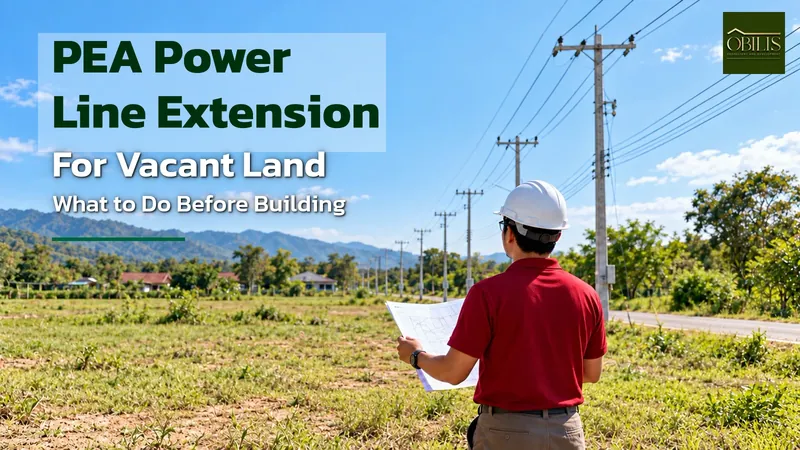
How to Request a PEA Power Line Extension for Vacant Land in Thailand
Vacant land with no electricity line can request a PEA power line extension through PEA's One Touch Service, which extends the line free for roughly up to 140 meters for meters up to 30 amps, within about 10 working days. This mainly applies inside municipal areas. You will need an ID card copy, house registration, and title deed, and registered farmers may qualify for a separate farmland extension programme whose amount varies by round and area.
- PEA extends low-voltage lines free for roughly up to 140 meters through One Touch Service.
- The free extension applies to meters up to 30 amps and takes about 10 working days.
- Land outside municipal or community areas may not automatically qualify for the free distance.
- Registered farmers may qualify for a separate agricultural power line subsidy program.
Why Many Vacant Plots in Isaan Still Have No Electricity Line
Vacant plots that sit outside the existing utility pole network — especially land carved out of a larger farm plot, or land down a newly opened soi — often haven’t yet been connected to the Provincial Electricity Authority’s (PEA) distribution grid. In these cases, it’s the landowner’s own responsibility to file the request for a PEA power line extension; it doesn’t happen automatically.
Many buyers assume electricity will simply “arrive” on its own once they start building a house, but in reality the extension request needs to begin before or during the building-permit process. It takes processing time, and PEA may need to check distance conditions first. Some owners only discover this after their contractor has already started construction and needs working power on site, which forces costly, unnecessary pauses to parts of the build.
Land in Khao Yai and Pak Chong that sits down long sois or on sloped terrain runs into this problem far more often than land inside Korat or Roi Et town centers, since the main utility poles usually run only along major roads. It gets even more complicated when a plot can only be reached by crossing someone else’s orchard or farmland before reaching the nearest pole, since that may require written consent from the neighboring landowner to run the line across their property.
How Far Can You Get a Free PEA Power Line Extension
PEA currently runs a program called One Touch Service, which extends the low-voltage distribution line free of charge for a distance of approximately up to 140 meters. This applies to applicants whose meter size doesn’t exceed 30 amps, and PEA aims to complete the work within about 10 working days. That service window applies inside community or municipal areas, so for empty land outside them, check the real timeframe with the local PEA office first (per PEA, the Provincial Electricity Authority).
This free-extension rule is aimed mainly at land inside municipal or established community areas. A vacant plot outside those zones, or one located far from the nearest existing pole, may not automatically qualify for the free distance allowance, so it’s worth checking directly with the local PEA office before finalizing a budget.
If the distance exceeds what’s covered for free, the applicant is responsible for the additional cost, and PEA has not published a fixed, general per-meter overage fee. It’s best to request an official extension quote from PEA staff to get a real number for that specific plot before committing to buy the land.
Documents You’ll Need for a PEA Power Line Extension Application
The basic paperwork usually required includes a copy of the applicant’s ID card, house registration, and a full copy of the land title deed or land rights document, along with a rough map or sketch showing the plot’s location and where the electricity connection is needed.
If the applicant is a company — for example, a developer buying land for a housing project — additional documents such as a corporate registration certificate and an electrical system drawing signed off by a licensed electrical engineer are usually needed too. Requirements can vary slightly between PEA offices, so it’s worth confirming the exact list with the local branch before preparing anything.
Having every document ready from the first visit cuts down on repeat trips to the PEA office, which matters most for landowners who don’t live in the area full-time. If a contractor or home-building company is handling the filing on the owner’s behalf, a clear written power of attorney should be provided to avoid follow-up problems later.
Options for Agricultural Land With No Electricity Yet
If the land purchased is registered as agricultural land and the owner is registered as a farmer, PEA runs a separate extension program for farmland, which covers part of the extension cost for applicants. The amount and conditions vary by programme round and area, so ask the local PEA office directly whether the current round is open and how much it covers.
This program suits owners planning to build a home on their own farmland over the long term, but it comes with conditions around farmer registration and proof of actual land use that must be confirmed against the criteria before filing a request.
Homeowners unsure whether their land qualifies should check with both the district agricultural office and the local PEA office, since the two are separate agencies that need to coordinate. Farmer registration can take several weeks to process, so it’s worth starting well ahead of any real construction planning.
Timing Your PEA Power Line Extension Request With the Build Schedule
The request for a power line extension should be filed in parallel with the building-permit process, not left until the house is nearly finished. Approval and the actual installation of poles take time, and if the land falls outside the free-distance criteria, there may also be a wait for PEA staff to schedule a site survey.
While waiting for permanent power, homeowners also need a separate temporary electricity connection for use during construction. This is its own application, with different conditions and timelines from the permanent connection, so both should be planned together from the start.
Keeping the contractor or home-building company informed of the electricity application’s status from the beginning helps them schedule construction work more accurately, avoiding pauses caused by a lack of power — especially for tasks that rely on continuous electric tools, such as steel-cutting equipment or water pumps for mixing concrete.
Check Electricity Conditions Before Buying Land, Not After
Cheap land in a location electricity hasn’t reached yet may not actually be a bargain once you factor in the extra cost of a power line extension that falls on the buyer. It’s also worth remembering that foreign nationals generally cannot own land directly in Thailand, so anyone comparing plots — through whatever structure they ultimately use to hold the land — should check the distance to the nearest utility pole before deciding, not after.
The OBILIS team often advises clients looking at land in Khao Yai, Pak Chong, or areas on the edge of town to check the power line distance with PEA alongside verifying the land title documents, so the full budget can be estimated as accurately as possible before closing the deal.
If you want a figure for the house you actually have in mind, try the budget planner first, or contact us for an estimate based on your real plan and land.
If a plot of interest turns out to be far from the existing line, that cost should be factored into the land price negotiation from the start, rather than becoming a surprise expense once construction actually begins.
Frequently Asked Questions
How much does it cost if vacant land is very far from the power line?
The extra cost beyond the free-extension distance depends on the actual distance and site conditions of each plot, and there isn’t a published general per-meter price list. It’s best to have PEA staff survey the site and provide an actual quote before deciding to buy the land.
Do permanent and temporary electricity during construction need separate applications?
Yes, they are two different requests. Temporary electricity is for construction work while the house isn’t finished yet, while permanent electricity can be requested once the house passes inspection and is ready for use. Homeowners should plan to file both requests in time with the construction schedule.
Is a power line extension different for agricultural land versus ordinary vacant land?
Land registered as agricultural land, with an owner registered as a farmer, may qualify for a separate program that helps fund extension costs, unlike ordinary vacant land, which follows the standard extension process. It’s worth checking with both the district agricultural office and PEA for clarity.
Key facts at a glance
| Free extension distance | up to roughly 140 meters |
|---|---|
| Meter size condition | up to 30 amps |
| Processing time | within 10 working days for community or municipal areas |
| Reference authority | Provincial Electricity Authority (PEA) |
| Agricultural land program | covers part of the cost; amount varies by programme round and area |
| Key documents needed | ID card, house registration, land title deed |
Frequently asked questions
How much does it cost if my land is very far from the nearest power pole?
The overage cost depends on the actual distance and site conditions for each plot; no fixed per-meter rate is published, so ask PEA to survey and quote directly.
Do I need separate applications for temporary and permanent electricity?
Yes, they're different requests. Temporary power covers the construction period, while permanent power is granted once the house passes inspection.
Is the extension process different for agricultural land versus vacant land?
Registered farmland may qualify for a dedicated cost-support program, unlike standard vacant land, which follows the regular extension process.
How far will PEA extend a power line for free?
PEA extends up to roughly 140 meters for free for meters up to 30 amps, completed within about 10 working days, under certain conditions.