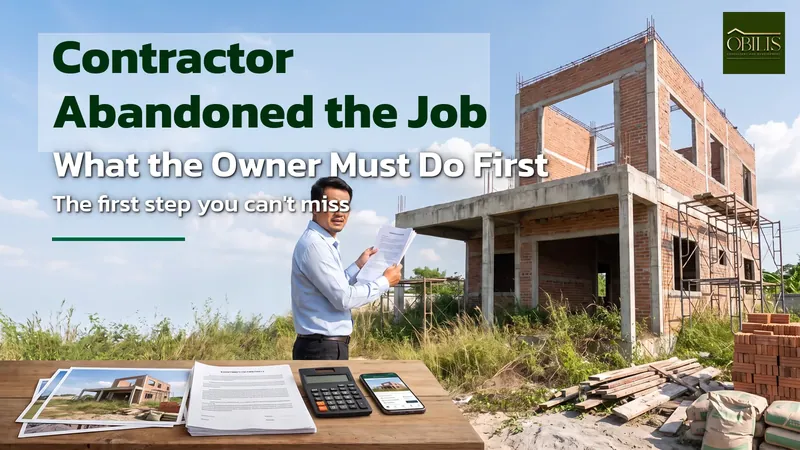
What should a homeowner do first when a contractor abandons the project in Thailand?
When a contractor abandons the project, first document the site with photos and video, then compare paid installments against work actually completed. Send a written notice giving a reasonable time to fix the work under Section 594 of the Civil and Commercial Code. If nothing changes, terminate under Section 593, claim a refund under Section 391, and file a complaint with OCPB through the 1166 hotline.
- Document the site with photos and video right away.
- Compare installments paid against work actually completed.
- Send a written notice with a reasonable deadline to fix the work.
- File a complaint with OCPB through the 1166 hotline if needed.
Contractor Abandons the Project: Warning Signs Every Homeowner Should Know
A contractor abandons the project when the building crew stops working on a house with no clear explanation and never returns by the date set in the contract. Homeowners in Korat, Roi Et and Pak Chong often discover this after already paying one or more installments. What makes it worse is not knowing what to do first, both legally and on the ground at the site.
The first warning sign is usually workers disappearing from the site for several days with no explanation. Ordered materials stop arriving, and the site foreman becomes unreachable by phone or by Line. Some houses are left at a vulnerable stage, such as a roof frame with no covering or brick walls with no waterproof render. Left too long, the seasonal rain common across Isaan can add real structural damage.
Another sign to watch for is subcontractors contacting the homeowner directly to say they were never paid, even though the homeowner already paid the main contractor. This is often where abandonment starts, because the main contractor may have used the money for something else. Homeowners should record the date and exact words of any subcontractor who raises this, since it becomes useful evidence later.
What Legal Rights a Homeowner Has When a Contractor Abandons the Project
A house-building contract is treated as a “contract for work” (สัญญาจ้างทำของ) under Section 587 of the Civil and Commercial Code (ประมวลกฎหมายแพ่งและพาณิชย์, Thailand’s civil law code). The contractor must complete the agreed work, and the homeowner must pay in the agreed installments. When the contractor fails that duty, the law gives the homeowner several ways to respond (citing the Civil and Commercial Code, Section 587).
Section 593 lets the homeowner terminate the contract immediately, without waiting for the agreed completion date, if the contractor fails to start work on time or falls so far behind that it is clearly going to miss the deadline through no fault of the homeowner. A contractor who disappears from the site for a long stretch, with no realistic way to finish on schedule, falls squarely under this condition (citing the Civil and Commercial Code, Section 593).
Section 594 applies to cases that have not yet reached outright abandonment, but where the work is clearly heading toward defects or a breach caused by the contractor. The homeowner may send a written notice demanding correction within “a reasonable time” (เวลาอันสมควร) stated in that notice. The law does not set a fixed number of days; the homeowner sets the reasonable time itself. If the contractor still fails to correct the work, the homeowner may hire someone else and bill the cost back to the original contractor (citing the Civil and Commercial Code, Section 594).
The First Steps to Take Immediately When a Contractor Abandons the Job
The first thing to do is document the current condition of the house completely. Photograph and film every part of the house, both what is finished and what is left unfinished, with the date clearly visible. This record will later be compared against the installments already paid, and it becomes essential evidence if a complaint or a lawsuit follows.
Next, pull out the construction contract and go through it in detail. Check how many installments have been paid, what stage of work each installment was tied to, and compare that against what has actually been completed on site. Many homeowners find they paid for more progress than was actually delivered, a figure that becomes central to any later refund claim.
Once the evidence is in hand, send the contractor a formal written notice. State the problem clearly and set a reasonable time for the contractor to return to work or correct the defects. Send it in a way that proves delivery, such as registered mail or a messaging app with a read receipt, because this letter is the starting point for exercising the rights under Section 594.
Terminating the Contract and Getting Your Money Back
Once the contract is terminated, Section 391 requires both parties to be restored to their position before the contract, as far as possible. Any amount the homeowner paid beyond the value of work actually completed must be refunded with interest from the date the contractor received it. Work that was genuinely completed is valued and paid for at its real worth, not at the value of the original installment schedule (citing the Civil and Commercial Code, Section 391).
In practice, the homeowner should get a new contractor to quote the cost of finishing the remaining work, and keep that quotation as evidence against what was already paid to the original contractor. The gap between those two figures becomes the basis for an additional damages claim, on top of any amount paid for work that was never delivered.
If the original contractor refuses to refund what is owed, the homeowner has the right to file a civil case to recover it. The evidence gathered from the start, the contract, receipts, site photos, and the written notice, all support the claim. For larger amounts, it is worth consulting a lawyer to assess the best approach for the case.
Where to File a Complaint and Get Help from Government Agencies
OCPB (the Office of the Consumer Protection Board, สำนักงานคณะกรรมการคุ้มครองผู้บริโภค) is the main agency that accepts complaints about contractor abandonment directly. Homeowners can reach it through the 1166 hotline, the ocpb.go.th website, the OCPB Connect app, or a local community justice center (citing OCPB, ocpb.go.th).
Residential house construction is classified as a “controlled contract business” under the 2016 Notification of the Contract Committee (ประกาศคณะกรรมการว่าด้วยสัญญา พ.ศ. 2559). It requires the contract to be written in Thai, with text no smaller than 2 millimeters, and to include the protective clauses the law sets out for homeowners. If the signed contract falls short of these requirements, OCPB can factor that into how it handles the complaint (citing the 2016 Notification of the Contract Committee on residential construction contracts).
OCPB has previously helped consumers recover money after a contractor abandonment, with one reported case recovering nearly 600,000 baht for the homeowner (citing OCPB, ocpb.go.th, and related news reports). Homeowners across Isaan who cannot easily travel to Bangkok can also file through their provincial Damrongtham Center (ศูนย์ดำรงธรรม) at the same time.
Preventing Contractor Abandonment from the Start of the Project
Most cases of a contractor abandoning the project can be prevented at the contract stage. A solid contract ties each payment installment to a specific stage of physical progress, not simply to the passage of time. Homeowners building a holiday home in Khao Yai or Pak Chong should be especially careful here, since they are usually not on site every day to check progress. It is also worth remembering that foreigners generally cannot own land outright in Thailand, which makes a clear, well-documented contract even more important when the property is registered through a Thai spouse, company, or long-term lease structure.
Before releasing each installment, the homeowner should inspect the site personally or send a trusted representative to inspect it, comparing actual progress against the contract every time before paying. Never pay ahead of the work just because the contractor asks; that is the easiest way for abandonment risk to build up unnoticed.
A home builder with a clear contract system and a structured inspection process for each payment stage reduces the risk of contractor abandonment from the outset. OBILIS, for example, ties its payment installments to the actual construction progress of each house. Homeowners planning to build in Korat or Roi Et should treat this as a priority before signing anything.
If you want a figure for the house you actually have in mind, try the budget planner first, or contact us for an estimate based on your real plan and land.
Related reading: Independent Contractor vs Home Building Company in Thailand: Which to Choose
Frequently Asked Questions
How many days of absence counts as a contractor abandoning the project under Thai law?
Thai law sets no fixed number of days. Section 593 of the Civil and Commercial Code lets the homeowner terminate the contract immediately once it is clear the contractor has not started on time or is delayed to the point the deadline will certainly be missed, without waiting for any set period to pass (citing the Civil and Commercial Code, Section 593).
I already paid for work that was never finished. How do I get a refund?
After terminating the contract under Section 391, the homeowner can claim back any amount paid beyond the real value of the completed work, plus interest. This requires evidence comparing the installments paid against the work actually finished on site (citing the Civil and Commercial Code, Section 391).
What documents do I need to file a complaint with OCPB?
Prepare the construction contract, receipts for every installment paid, photos and video of the current site condition, and a copy of the written notice sent to the contractor. File through the 1166 hotline or the ocpb.go.th website (citing OCPB, ocpb.go.th).
Key facts at a glance
| Section 593 | Right to terminate immediately when the contractor fails to start on time or is clearly delayed |
|---|---|
| Section 594 | Right to send written notice demanding correction within a reasonable time |
| Section 391 | Right to a refund with interest after termination |
| OCPB hotline | 1166 |
| 2016 Notification of the Contract Committee | Requires Thai-language contracts with text no smaller than 2 millimeters |
| OCPB case example | Helped recover nearly 600,000 baht for a homeowner |
Frequently asked questions
How many days of absence counts as abandonment under Thai law?
Thai law sets no fixed number of days. Section 593 lets the homeowner terminate immediately once it is clear the contractor will not finish on time.
I already paid for unfinished work. How do I get a refund?
Terminate under Section 391 and claim back any amount paid beyond the real value of completed work, plus interest.
What documents do I need to file a complaint with OCPB?
The contract, payment receipts, site photos and video, and a copy of the written notice sent to the contractor.
How much notice must I give before terminating the contract?
There is no fixed number of days; the homeowner sets a reasonable time in the written notice under Section 594, or can terminate immediately under Section 593 if the conditions are met.