Pak Chong Zoning
Pak Chong zoning is the land-use plan set by Thailand's Department of Public Works and Town & Country Planning. Before buying land near Khao Yai, check which zoning colour a plot falls under and whether it overlaps a forest reserve or national park boundary. Verify this with the Nakhon Ratchasima Provincial Public Works and Town Planning Office or the local Sub-district Administrative Organization, and never rely solely on what a land broker tells you.
- Check the zoning colour with the Nakhon Ratchasima Public Works and Town Planning Office before buying.
- Land near Khao Yai National Park may carry extra restrictions beyond basic zoning.
- Always verify the land title type alongside the zoning, not one or the other alone.
- Never rely solely on a broker's word that land can definitely be built on.
What Pak Chong Zoning Is and Why You Should Check It Before Buying Land
Pak Chong zoning refers to the land-use plan set by Thailand’s Department of Public Works and Town & Country Planning (DPT), which controls what each area of land can be used for — full residential construction, limited construction, or no construction of certain building types at all. Each town plan also sets building height and density limits for each zone, not just whether building is allowed.
People buying land around Khao Yai and Pak Chong to build a home or a vacation house often focus only on the price and the mountain view, forgetting to check which zoning colour the plot falls under, which directly affects whether a building permit will be approved. A plot priced unusually below market can sometimes carry a zoning restriction the seller never mentioned.
A common problem is discovering a zoning restriction or protected-area boundary only after the land has already been paid for. Checking zoning should always happen before transferring ownership, not after the sale is agreed. Some buyers even put down a deposit first, only to later find the land is restricted, losing both time and part of a deposit that may not be fully refundable.
What Each Zoning Colour Means for Building a House
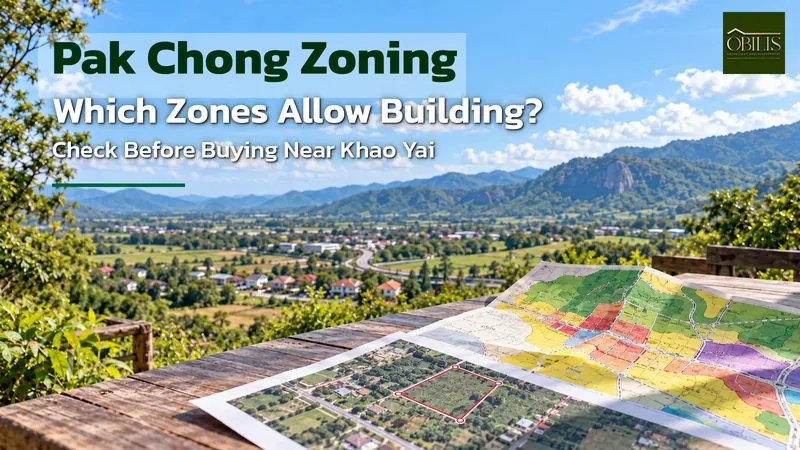
Thailand’s zoning system uses colours to classify land use, set out in each province’s or town’s comprehensive plan, which is enacted as law. As a general rule used nationwide, yellow usually means low-density residential, orange means medium-density residential, and green is usually tied to agricultural or open land meant to preserve the environment.
Parts of Khao Yai and Pak Chong sit close to national park and forest reserve boundaries, which often carry extra restrictions on building height, setback distances, or the type of activity allowed — on top of the basic zoning colour. These extra rules are sometimes far stricter than the basic colour, so it isn’t safe to assume construction is allowed from the base colour alone.
The exact zoning boundaries for individual plots in Pak Chong can change with each new comprehensive plan announcement. This article only explains the general principle — the real details for the specific plot you’re interested in must always be verified directly with the responsible authority.
Common Restrictions on Land Around Khao Yai and Pak Chong
The most common restriction is land sitting near or overlapping the boundary of a national forest reserve or Khao Yai National Park, governed by separate laws from general zoning. Building in these areas may require extra permits from the relevant authorities. Some plots have only a portion overlapping a forest reserve boundary, so owners need to verify the exact boundary line before laying out where the house will actually sit.
Some plots also carry SPK (Sor Por Kor) documents, which are for agricultural land reform and mainly allow farming use, or Nor Sor 3 Kor, a certificate of use that gives possession rights but not full ownership like a chanote title deed. Always check the title type alongside the zoning, not one or the other alone. Some of these title types also restrict transferring the land to someone else, affecting long-term resale plans, not just construction. It’s also worth noting that foreigners generally cannot own land in Thailand outright, which is a separate consideration from zoning when planning any purchase.
Another commonly overlooked point is the setback distance from public roads and natural waterways. Many sloped plots in Khao Yai have small streams running through them that the previous owner never mentioned, which affects where a house can actually be positioned on the plot.
How to Check Pak Chong Zoning Yourself Before Deciding
The most direct way to check Pak Chong zoning is to contact the Nakhon Ratchasima Provincial Public Works and Town Planning Office directly, bringing the title deed number or land coordinates to ask about. Staff will help confirm which zoning colour the plot falls under and whether extra requirements apply. It’s worth calling ahead to schedule, since some periods see a high volume of people coming in to check.
Another route is asking the local Sub-district Administrative Organization (SAO) or municipal office in the Pak Chong area where the land sits, since local authorities often have the most recently updated zoning data and local ordinances on hand. Some local offices can also tell you about planned future road alignments that might affect the plot, details the provincial office may not have.
Don’t rely solely on what a land broker tells you about whether a plot can be built on — some sellers may not know the current zoning details or may be working from outdated information. Verifying it yourself with the government office directly is a step you shouldn’t skip.
Additional Documents and Authorities to Contact
Besides the Public Works and Town Planning office, check on forest reserve and national park boundaries with the Royal Forest Department or the Department of National Parks, Wildlife and Plant Conservation, especially for land near the mountain range. Checking with these agencies in advance also saves time compared to discovering a problem only after applying for a building permit.
Documents worth bringing every time include a copy of the title deed, coordinates or the land parcel map, and any layout plan from the seller if available, so staff can pinpoint the exact location. If possible, request an official parcel map from the Land Department directly rather than relying only on a rough sketch from the seller.
If you also plan to bring in electricity and water, check with the local PEA and provincial waterworks authority alongside your land search, since some plots sit outside existing service boundaries, meaning extra costs to extend the network.
Plan Carefully Before Buying Land
Checking zoning before buying land takes only a few days but prevents problems that are far harder to fix afterward, such as buying land you can’t build on as planned, or having to redesign the whole house because of a restriction you didn’t know about. Compared with the value of the entire plot, those few days of checking are well worth the reduced risk.
The OBILIS team advises clients interested in land around Khao Yai and Pak Chong to always check zoning and title documents alongside the view and location, since the most beautiful-looking plot might not be the one you can actually build the house you want on. A team with real local experience often knows the specific pitfalls of each zone, saving research time compared with starting from scratch.
If you want a rough figure for the house you have in mind, try the budget planner first, or contact us for advice based on your actual plan and land.
If you’re unsure how to verify these documents yourself, consult a designer or home-building company experienced working in the Khao Yai area before transferring money for the land, to reduce the risk of a problem you can’t fix later.
Frequently Asked Questions
Where can I check Pak Chong zoning?
Check with the Nakhon Ratchasima Provincial Public Works and Town Planning Office, or ask the local Sub-district Administrative Organization (SAO) or municipal office in the Pak Chong area where the land sits. Always bring the title deed number or land coordinates so staff can check the exact plot.
Can I build a house on land near Khao Yai National Park?
It depends on the distance from the boundary and the specific law governing that area, which can be stricter than general zoning. Check with the Department of National Parks, Wildlife and Plant Conservation alongside the Public Works and Town Planning office before deciding to buy.
The broker says the land can definitely be built on — do I still need to check zoning myself?
Yes, always check yourself, since some brokers may not know the latest zoning details or specific restrictions on that plot. Verifying directly with the relevant government office is the only reliable way to be sure before you decide to buy.
Key facts at a glance
| Main authority | Nakhon Ratchasima Provincial Public Works and Town Planning Office |
|---|---|
| Yellow zone | Low-density residential |
| Orange zone | Medium-density residential |
| Extra restriction | Land near Khao Yai National Park may have separate governing law |
| Documents to prepare | Title deed copy, land coordinates, and parcel map |
| Other relevant agencies | Royal Forest Department, National Parks Dept., PEA, provincial waterworks |
Frequently asked questions
Where can I check Pak Chong zoning?
Check with the Nakhon Ratchasima Provincial Public Works and Town Planning Office, or the local Sub-district Administrative Organization (SAO) in the Pak Chong area.
Can I build near Khao Yai National Park?
It depends on distance from the boundary and area-specific law; check with the Department of National Parks before buying.
The broker says it's definitely buildable, do I still need to check?
Yes, always verify directly with the relevant government office yourself.
What do the zoning colours mean?
Yellow usually means low-density residential, orange means medium-density, and green usually relates to agricultural or open land.