Soil Boring Test Before Piling: How Necessary Is It for a House
A soil boring test before piling means drilling to survey soil layers before designing the foundation and choosing pile length, since soil can vary greatly even between adjoining plots, especially former rice fields or freshly filled land. Thailand's 2023 foundation regulation sets a general framework for ground load-bearing capacity. Even where the law may not require it for every ordinary house, testing still reduces the risk of uneven settling and cracking.
- A soil boring test before piling surveys soil layers before the foundation is designed and pile length chosen.
- Soil layers can differ greatly even between adjoining plots, especially former rice fields or filled land.
- Thailand's 2023 foundation regulation sets a general framework for ground load-bearing capacity.
- Skipping a soil test risks uneven settling and wall cracking that may only show up years later.
What Is a Soil Boring Test Before Piling, and Why Does It Matter
A soil boring test before piling is a survey engineers carry out by drilling into the ground at the exact spot where a house will be built, to find out what kind of soil exists at each depth and how much weight it can bear, before foundations are designed and pile length is chosen.
Many people assume soil in the same neighborhood is roughly the same, so they simply copy the pile length used next door. In reality, soil layers can vary even between adjoining plots, especially in areas that used to be rice fields, old ponds, or previously filled land.
The test results aren’t just for an engineer to file away — they’re the starting data used to calculate what kind of foundation is needed, how long the piles should be, and whether the structure can actually bear the building’s weight safely.
What You Risk by Skipping a Soil Boring Test Before Piling
The most common risk is choosing piles that are too short because the length was guessed from a neighboring house. When the soil turns out softer or deeper than expected, the piles can’t bear the load the design assumed they would.
The result usually isn’t a sudden collapse, but uneven settling across different points of the house, showing up over time as wall cracks, doors and windows that no longer close properly, or a floor that tilts slightly — often only noticed after several rainy seasons have passed.
Fixing a house that has already settled unevenly is almost always more expensive and disruptive than testing the soil up front would have been, since it often means underpinning the foundation or jacking the house back up — while a soil boring test is just one step before construction even begins.
What Thai Foundation Law Says About This
Thailand has a ministerial regulation on building foundations and the ground supporting them dated B.E. 2566 (2023), published in the Royal Gazette on 31 August 2023 and taking effect roughly 180 days later (source: the Association of Siamese Architects, which published the text of this regulation).
This regulation sets out a general framework for ground load-bearing capacity and foundation requirements, but exactly which building types are required to have a soil test report as part of their design should be confirmed with your design engineer or local authority, since this is a technical detail that needs to be read alongside professional engineering standards.
For an ordinary residential house that doesn’t fall into the large-building category, the law may not mandate soil testing for every single house — but that doesn’t mean you shouldn’t do it. Damage from an unevenly settling house can happen to a home of any size, not just large buildings.
How a Soil Boring Test Before Piling Actually Works
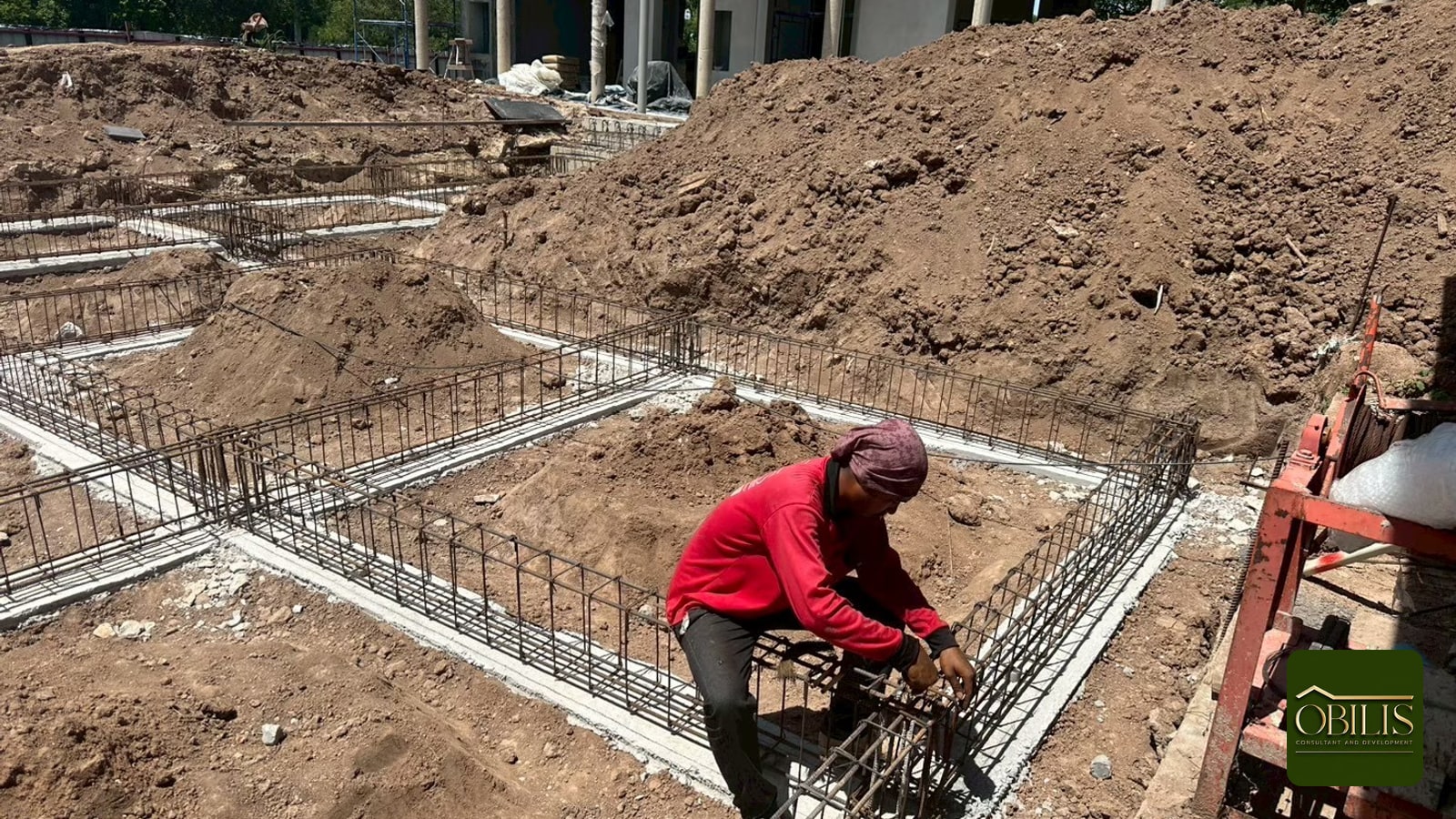
First, an engineer brings drilling equipment to the exact spot where the foundation will sit, extracting soil samples at each depth layer and testing the load-bearing capacity of each one. This work usually happens before site leveling even begins.
The data is then analyzed and compiled into a soil test report, showing roughly what depth the firm, load-bearing soil layer sits at — a depth that varies by location, with no single figure that applies to every plot.
The structural engineer uses this report to calculate pile length and design the foundation to match the actual soil conditions, rather than estimating from experience or a neighboring house alone.
What Kind of Isan Soil Needs Extra Caution
Much of the flat land around Korat and Roi Et used to be rice paddy, and the topsoil there is often soft clay that holds water and compresses easily under load — quite different from the foothill areas around Khao Yai and Pak Chong, where some spots are laterite or rocky soil with better bearing capacity, though other spots there have been freshly filled as well.
Land that’s been filled to raise its level before being sold is another area to watch closely, since freshly filled ground needs time to settle naturally before it’s compact enough. Piling too soon, without testing, risks results that don’t match the ground’s actual long-term behavior.
Given how much soil conditions vary from one spot to the next, a neighboring plot’s soil test results shouldn’t be treated as a substitute for testing the actual plot you’re building on, even if it’s on the same lane — soil type can change within just a few dozen meters.
Who to Talk to About Soil Testing Before You Start Piling
Bring this up with your structural engineer or house-building company during the design stage, not on the day the crew is ready to start piling — testing and analysis take lead time before real construction can begin.
If the land has an unusual history — a former pond, repeated flooding, or recent land filling — flag that with your engineer from the start, so they can decide how many test points are needed to cover the whole house footprint properly.
The OBILIS team treats ground condition checks as a priority before designing foundations for every house we build in Korat and Roi Et, so piles and foundations match the plot’s actual soil rather than a guess based on the house next door.
If you want a figure for the house you actually have in mind, try the budget planner first, or contact us for an estimate based on your real plan and land.
Related reading: Flood-Prone Land: How High to Raise Your Floor in Thailand
Frequently Asked Questions
Does a single-story house need a soil boring test before piling?
Even though a single-story house carries less load than a two-story one, a soil boring test before piling still helps reduce the risk of uneven settling if the land has a history of soft soil or recent filling. Talk to a structural engineer to assess whether it’s needed for your specific plot.
How long does a soil boring test before piling take?
The timeline depends on how many points are drilled and how deep, plus the time needed to analyze the samples and prepare the report. Build this time into your construction schedule at the design stage, not as an afterthought right before piling is due to start.
What happens if the test finds very soft soil?
The engineer will adjust the foundation design to match the results — for example, changing the pile length or the type of foundation used — which may push this part of your budget higher than first estimated. That’s still a better outcome than leaving your house at risk of settling later on.
ข้อมูลสำคัญโดยสรุป
| Thailand's foundation regulation | B.E. 2566 (2023), Royal Gazette 31 Aug 2023, effective roughly 180 days later |
|---|---|
| Source of the regulation text | Published by the Association of Siamese Architects |
| Main risk of skipping the test | Piles too short to bear the load the design assumed |
| Signs of uneven house settling | Wall cracks, doors/windows not closing properly, a tilted floor |
| Isan soil to watch closely | Former rice paddy soil or freshly filled land not yet fully settled |
| Who to consult before piling | A structural engineer or house-building company, at the design stage |
คำถามที่พบบ่อย
Does a single-story house need a soil boring test before piling?
Even though a single-story house carries less load than a two-story one, a soil boring test before piling still helps reduce the risk of uneven settling if the land has a history of soft soil or recent filling. Talk to a structural engineer to assess whether it's needed.
How long does a soil boring test before piling take?
The timeline depends on how many points are drilled and how deep, plus the time needed to analyze the samples and prepare the report. Build this time into your construction schedule at the design stage, not as an afterthought.
What happens if the test finds very soft soil?
The engineer will adjust the foundation design to match the results, such as changing the pile length or foundation type, which may push this part of your budget higher than first estimated. That's still better than risking settling later.
Can I use a neighboring plot's soil test instead of testing my own?
No, this isn't advisable, since soil conditions can change within just a few dozen meters. Relying on a neighbor's results risks a foundation design that doesn't match your own plot's actual conditions.